
 Your location:Home → low-voltage electrical apparatus → relay → Synchronous grounding relay → BT-1B type synchronous inspection relay
 |
Product name: | BT-1B type synchronous inspection relay | |||||
| specification: |   Zoom in on the image Zoom in on the image |
||||||
| Category: | low-voltage electrical apparatus -- Synchronous grounding relay | ||||||
| |
Price: | factory price | |||||
| Brand: | |||||||
| Place of Origin: | China | ||||||
| |
Available Quantity: | batch | |||||
| delivery cycle: | Spot goods (or inquire by telephone) | ||||||
 |
|
||||||
Purpose:
The BT-1B synchronous check relay is used in the automatic reclosing circuit of the two terminal power supply system as a checking element for voltage and synchronization.
Working Principle:
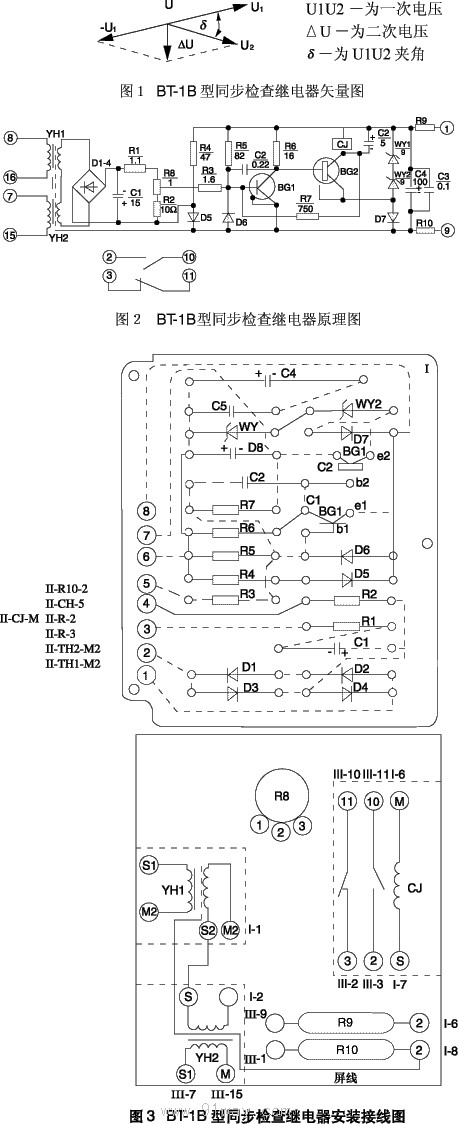
2.1 The relay consists of voltage transformers YH1 and YH2, rectification and filtering circuits, triggers, and reed relays. Installed in a modular plug-in housing. The schematic diagram of the principle wiring is shown in Figure 2.
2.2 Two AC voltages (or currents) are respectively applied to the two primary windings of voltage transformers YH1 and YH2, and the secondary windings are connected to the rectifier bridge with opposite polarity. When two voltages (or currents) are in phase at once, due to the reverse polarity connection of the secondary winding, the potential generated on the voltage transformer cancels each other out, and the secondary output voltage is equal to zero (unbalanced voltage does not exceed 0.5V). The trigger is still in its original state (BG1 conduction, BG2 cutoff), and the reed relay does not operate. When two voltages (or currents) are in different phases at once, the potential generated on the voltage transformer cannot cancel each other out, while a potential is generated in the second phase. The magnitude of the secondary output voltage is related to the phase difference and amplitude of the two voltages (or currents) at once. When the amplitude is constant, the larger the phase difference, the larger the secondary output voltage, and vice versa. The vector diagram is shown in Figure 1.
2.3 After rectification and filtering, the secondary output voltage is applied to the trigger. When the signal voltage reaches the set value, the trigger flips (BG1 is turned off, BG2 is turned on), the reed relay acts, the dynamic breaking contact opens, and the dynamic closing contact closes.
When any input voltage (or current) is zero or very low, the situation is the same as when two voltages (or currents) are in different phases, and the relay should also immediately act.
The setting of the 2.5 relay action angle is achieved using potentiometer R8.
The BT-1B synchronous inspection relay is a protruding plug-in structure (T) type.
Main technical parameters:
3.1 According to the rated voltage or rated current, the specifications of the relay are shown in Table 1
3.2 DC rated voltage: 220V, 110V, 48V.
3.3 Rated frequency: 50Hz.
3.4 Contact form: dynamic connection, dynamic disconnection.
3.5 Action angle setting range: 20 ° to 40 °.
3.6 Return coefficient: not less than 0.85.
3.7 DC power supply variation: When operating at 220V and 110V, it is allowed to vary within the range of 80-110%; At 48V, it is allowed to vary within the range of 90-110%, and the relay should be able to work normally.
3.8 Power consumption: The relay AC circuit shall not exceed 1VA; the DC circuit shall not exceed 6W at 220V; the power consumption shall not exceed 4W at 110V; and the power consumption shall not exceed 2W at 48V.
3.9 Contact breaking capacity: In a DC inductive load circuit with a voltage not exceeding 220V and a current not exceeding 0.2A (time constant not exceeding 5ms ± 0.75), the breaking capacity is 25W, and in an AC circuit (coso=0.4 ± 0.1), it is 30VA.
3.10 Lifespan: 5000 cycles.
3.11 Weight: Approximately 1.05kg.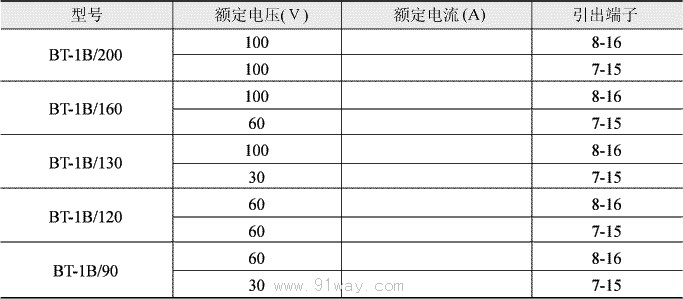
Wiring diagram behind the relay:
The installation wiring diagram is shown in Figure 3.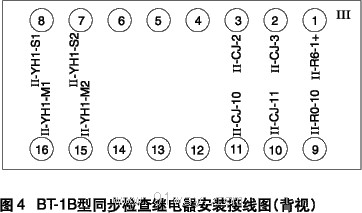
Relay external dimensions and opening dimensions:
The appearance and installation dimensions of the BT-1B synchronous inspection relay are shown in Figure 4 of the general structural system.
Ordering instructions:
4.1 Name and model of relay.
4.2 Rated values of relays.
4.3 Order quantity.
4.4 Delivery address.
 Related Products:
 low-voltage circuit breaker low-voltage contactor Low voltage transformer relay
  thermal relay Temperature relay time relay Universal relay intermediate relay power relay current relay overcurrent relay voltage relay signal relay Flash relay Differential relay Impact relay Position relay Frequency relay Phase relay Locking relay pressure relay gas relay Coaxial relay Polarized relay automotive relay Leakage relay Phase failure relay solid state relay electromagnetic relay Explosion proof relay Module relay Other relays Relay socket Reclosing relay Acceleration relay Power direction relay Synchronous grounding relay
  Insulation monitoring relay Counter | timer Low-voltage fuse starter electromagnet resistor Low-voltage arrester power capacitor Low voltage reactor dual power switch Low voltage isolator changeover switch Master Electrical Appliance terminal block plug socket electromagnetic chuck Electrotechnical equipment lighting distribution box Low voltage protector Electric cabinet door lock handle Building electrical appliances
 Home|Quality Commitment|Ordering|Payment method|product delivery|support|Disclaimer|Contact Us
Copyright®2011 www.91way.com Copyright.
Phone:+86-21-66770508 +86-13916500500 Fax:+86-21-66108310
Email:91way@163.com Wechat:40606422
沪ICP备2021005791号  沪公网安备31010702003255号

