
 Your location:Home → low-voltage electrical apparatus → relay → Power direction relay → LG-11,LG-12 type power direction relay
 |
Product name: | LG-11,LG-12 type power direction relay | |||||
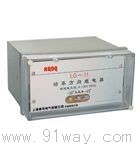
| specification: |   Zoom in on the image Zoom in on the image |
||||||
| Category: | low-voltage electrical apparatus -- Power direction relay | ||||||
| |
Price: | factory price | |||||
| Brand: | |||||||
| Place of Origin: | China | ||||||
| |
Available Quantity: | batch | |||||
| delivery cycle: | Spot goods (or inquire by telephone) | ||||||
 |
|
||||||
1 Purpose
LG-11 and LG-12 power direction relays are used as power direction discrimination elements in direction protection, with LG-11 used for phase to phase short circuit protection and LG-12 used for ground short circuit protection.
2 Structure and principle
The relay adopts a plug-in structure, and the same core can be used for general embedded A32K. The principle circuit diagram of the relay is shown in Figure 5 and Figure 6, and the appearance and installation dimensions are shown in Figure 7.
The relay is constructed based on the principle of rectification, and the absolute value of the comprehensive current and voltage is compared. Its operating mode is as follows:
For LG-11 type: | IZ+K1U |>| IZ-K1U | (1)
For LG-12 type: | IOZ+KOUO |>| IOZ - KOUO | (2)
In the formula, Z is the transfer impedance of the reactive transformer DKB
That is, Z=| secondary voltage of DKB |/| primary voltage of DKB | * e ^ ia (3)
K1 is the voltage circuit conversion coefficient for LG-11B, and K2 is the voltage circuit conversion coefficient for LG-12B.
K1=| Secondary voltage of YB |/| Voltage at relay terminals | * e ^ i β (4)
K0=| Secondary voltage of YB0 |/| Relay terminal voltage | (5)
In equation (3), α represents the transfer angle of the DKB secondary voltage to the primary current, and in equation (4), β represents the transfer angle of the voltage converter. Due to the use of a resonant circuit in the LG-11B model, when the voltage resonates, the angle is 90 °, while in the LG-12B model, the voltage circuit uses a transformer, so there is no angle change, that is, KO is the change of the transformer.
In equation (3), α represents the transfer angle of the DKB secondary voltage to the primary current, and in equation (4), β represents the transfer angle of the voltage converter. Due to the use of a resonant circuit in the LG-11B model, when the voltage resonates, the angle is 90 °, while in the LG-12B model, the voltage circuit uses a transformer, so there is no angle change, that is, KO is the change of the transformer.
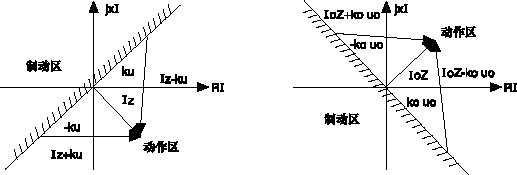
The first term in equations (1) and (2) is the operating voltage, and the second term is the braking voltage. When the operating voltage is greater than the braking voltage, the relay operates. When the braking voltage is greater than the operating voltage, the relay brakes. When the operating voltage is equal to the braking voltage, it becomes a boundary condition.
|
Figure 1 LG-11 action boundary |
Figure 2 LG-12 Action Boundary |
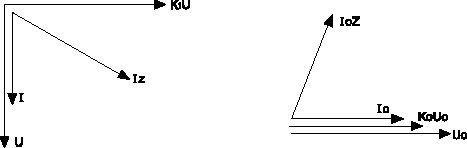
| Figure 1 LG-11B Vector Diagram | Figure 2 LG-12B Vector Diagram |
Technical data of 3 LG-11 and LG-12 power direction relays
3.1 Rated data
Rated current: 5A or 1A.
Rated voltage: 100V.
Rated frequency: 50Hz.
3.2 Sensitivity angle of relay: LG-11 type, -30 ° or -45 °, LG-12 type+70 °; The error of the sensitive angle is ± 5 °.
When the rated current is applied at a small sensitive angle, the operating voltage of the relay shall not exceed 2V.
3.4 Return coefficient: The ratio of the return voltage to the operating voltage of the relay shall not be less than 0.45.
3.5 Action time: For the LG-11 type, when the voltage suddenly drops by 4 times the rated minimum action voltage and the current rises from 0 to the rated current at the sensitive angle, the action time is not more than 30mS; for the LG-12 type, when the rated current and 4 times the minimum action voltage are suddenly added at the sensitive angle, the action time is not more than 40mS.
3.6 Memory time: For the LG-11 type, when the simulated protection outlet is short circuited at the sensitive angle, and the voltage suddenly drops from 100V to 0 at rated current and 10 times rated current, the relay should reliably operate, and its polarization relay action holding time should not be less than 50mS.
3.7 Power consumption: The current circuit shall not exceed 6VA, and the voltage circuit shall not exceed 20VA.
3.8 Relays can withstand 1.1 times the rated voltage and current for a long time.
When the voltage is not greater than 220V and the current is not greater than lA, the contact can disconnect a DC inductive load (time constant not greater than 5 × 10⁻³s) of 20W.
The insulation resistance between the relay circuit and the casing shall not be less than 10M Ω at a temperature of+40 ℃ and a relative humidity of 85%.
3.11 The insulation strength of the relay should withstand a withstand voltage test of 2kV at 50Hz for 1 minute without breakdown or flashover.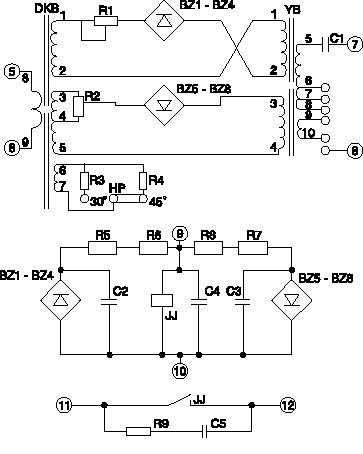
Figure 5 Principle circuit of LG-11B power direction relay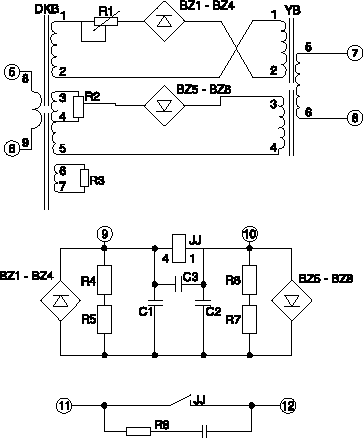
Figure 6 Schematic circuit diagram of LG-12 power direction relay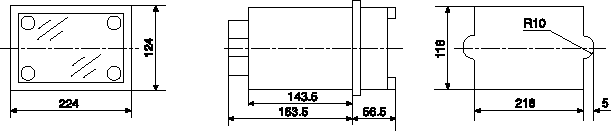
Figure 7: Outline and Installation Dimensions of LG-11 12 Power Direction Relay
4. Use and maintenance
Before use, the relay should first be checked for any damage during transportation. Mechanical inspection should be carried out to ensure that all screws are tightened and all welding points are secure and reliable. Then, the polarized relay should be checked. Polarized relays (2) - (3) should be short circuited, and current should be applied to (1) and (4), with (4) being of positive polarity. The operating current should not exceed 1mA, the return coefficient should not be less than 0.5, and the contact gap should not be less than 0.2mm. If any non-compliance is found, the left stop screw can be adjusted to change the operating current value, and the right stop screw can be adjusted to change the return current value. If the adjustment of the stop screw does not meet the requirements, it is allowed to move the porcelain seat position to adjust until the requirements are met.
After adjusting the polarization relay, plug it in and perform an electrical performance check. First, perform a creep check. The voltage circuit is short circuited by 20 Ω, and the current circuit is connected to the rated current. Measure the voltage on the polarization relay coil, i.e. terminals (9) and (10), and adjust R1 to make the voltage zero. Then apply a voltage of 100V to the voltage circuit and open the current circuit to measure the voltage of the polarization relay coil. Adjust R2 to zero and repeatedly adjust the voltage and current creep to make the voltage of the graded relay coil zero. Then suddenly add or remove 10 times the rated current or 100V voltage under the above conditions. There should be no bird pecking phenomenon at the relay contacts. If bird pecking phenomenon is found at the contacts when cutting off high current or 100V voltage, the comparison circuit resistor or capacitor can be replaced to ensure that the discharge time constant of the braking circuit capacitor is not less than that of the working circuit capacitor. After replacement, the submersible adjustment should be carried out again. After the submersible adjustment is completed, the potentiometer brake nut should be locked, and then the sensitivity angle, sensitivity, and return coefficient of the relay should be checked to meet the technical requirements. For the LG-11 type, if the sensitivity angle exceeds the tolerance, the voltage resonance circuit should be checked for imbalance. When a voltage of 100V is applied, Uc-UL=10-15V should be met. This can be achieved by changing the inductance tap and adding or removing a small winding. At the same time, a memory characteristic test should be conducted. When a short circuit is simulated at the outlet, the voltage suddenly drops from 100V to zero, and the current is not more than 0.2 times the rated current, the relay should reliably operate. Then, a transient check should be conducted. At the reverse direction of the maximum sensitivity angle, when 10 times the rated current is suddenly applied and the 100V voltage suddenly drops to zero, the relay should have no bird pecking phenomenon.
5 Ordering Instructions
5.1 Product model and name.
5.2 Rated current.
5.3 Order quantity.
 Related Products:
 low-voltage circuit breaker low-voltage contactor Low voltage transformer relay
  thermal relay Temperature relay time relay Universal relay intermediate relay power relay current relay overcurrent relay voltage relay signal relay Flash relay Differential relay Impact relay Position relay Frequency relay Phase relay Locking relay pressure relay gas relay Coaxial relay Polarized relay automotive relay Leakage relay Phase failure relay solid state relay electromagnetic relay Explosion proof relay Module relay Other relays Relay socket Reclosing relay Acceleration relay Power direction relay
  Synchronous grounding relay Insulation monitoring relay Counter | timer Low-voltage fuse starter electromagnet resistor Low-voltage arrester power capacitor Low voltage reactor dual power switch Low voltage isolator changeover switch Master Electrical Appliance terminal block plug socket electromagnetic chuck Electrotechnical equipment lighting distribution box Low voltage protector Electric cabinet door lock handle Building electrical appliances
 Home|Quality Commitment|Ordering|Payment method|product delivery|support|Disclaimer|Contact Us
Copyright®2011 www.91way.com Copyright.
Phone:+86-21-66770508 +86-13916500500 Fax:+86-21-66108310
Email:91way@163.com Wechat:40606422
沪ICP备2021005791号  沪公网安备31010702003255号

