
 Your location:Home → low-voltage electrical apparatus → Master Electrical Appliance → micro switch → LXW5 series micro switch
 |
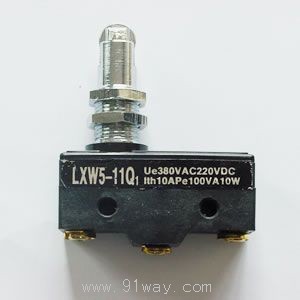
Product name: | LXW5 series micro switch | |||||
| specification: |   Zoom in on the image Zoom in on the image |
||||||
| Category: | low-voltage electrical apparatus -- micro switch | ||||||
| |
Price: | factory price | |||||
| Brand: | Shanghai | ||||||
| Place of Origin: | China | ||||||
| |
Available Quantity: | batch | |||||
| delivery cycle: | Spot goods (or inquire by telephone) | ||||||
 |
|
||||||
Characteristics and Applications:
The LXW5 series micro switch has adjacent contact elements that are not separated electrically, and is suitable for use in electrical systems with an AC frequency of 50Hz and a maximum working voltage of 220V for stroke detection, protection, and interlocking.
The structural characteristics and operating principle of the switch:
The LXW5 microswitch is a momentary single break electrical component that uses a normally closed contact, a normally open contact, and a common jumping elastic contact piece supported on a metal bracket as the moving contact.
When the switch is subjected to external forces (such as impact blocks) and the contact piece is compressed beyond the dead point through the operating element, even if the normally closed and normally open contacts are instantly switched, when the external force decreases to a certain value (less than the reset force), the contacts will immediately automatically reset to their original state.
LXW5 series micro switch classification:
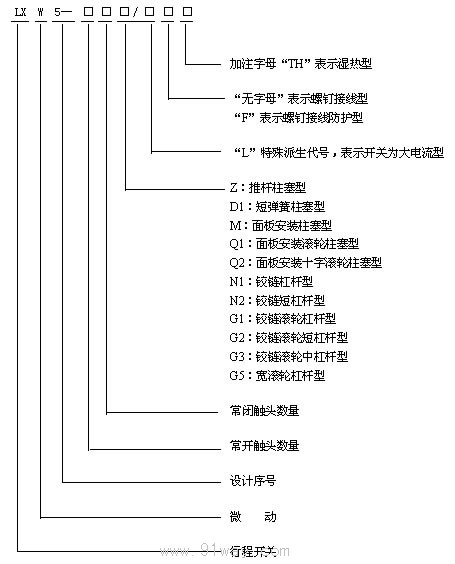
1. Classified by structural type:
a) Push rod plunger type;
b) Short spring plunger type;
c) Panel installation plunger type;
d) Panel installation roller plunger type;
e) Hinge lever type;
f) Hinge roller lever type;
g) Wide roller lever type.
2. Divided by wiring form
a) Screw type;
b) Screw protection type.
Use categories and basic parameters:
1. Use category
The usage categories of switches are shown in Table 1:
|
model |
Type of electric current |
Usage category |
typical use |
|
LXW5 |
communication |
AC—15 |
Control the load of the AC electromagnet |
|
direct current |
DC—13 |
Control the load of DC electromagnet | |
|
LXW5/L |
communication |
AC—12 |
Solid state loads that control resistive loads and optoelectronic coupling isolation |
|
direct current |
DC—12 |
Solid state loads that control resistive loads and optoelectronic coupling isolation |
2. Basic parameters
The basic parameters of the switch are shown in Table 2:
|
model |
Rated voltage V |
Rated control capacity |
Agreed heating current A |
Number of contacts | ||
|
Chang Fen |
Chang He | |||||
|
LXW5 |
communication |
three hundred and eighty |
100VA |
ten |
one |
one |
|
direct current |
two hundred and twenty |
10W | ||||
|
LXW5/L |
communication |
three hundred and eighty |
Exchange AC100VA |
fifteen | ||
|
direct current |
two hundred and twenty |
DC 66W | ||||
|
Type of electric current |
Usage category |
Rated working voltage |
Rated working capacity |
Connect |
Cut off |
Lifespan times | ||||
|
AC |
AC-15 |
380V |
100VA |
I/Ie |
U/Ue |
COSφ |
I/Ie |
U/Ue |
COSφ |
60×10four |
|
ten |
one |
zero point seven |
ten |
one |
zero point seven | |||||
|
DC |
DC-13 |
220V |
10W |
I/Ie |
U/Ue |
Tzero point nine five |
I/Ie |
U/Ue |
Tzero point nine five |
30×10four |
|
one |
one |
60ms |
one |
one |
60ms | |||||
Table 4 (High Current Type)
|
Type of electric current |
Usage category |
Rated working voltage |
Rated work |
Connection and disconnection capability |
Lifespan times time | |||||
|
Heater load |
Incandescent lamp load |
Electric motors and relays Spiral coil load Tzero point nine five | ||||||||
|
connect |
segmentation |
connect |
segmentation |
connect |
segmentation | |||||
|
AC |
AC-12 |
380V |
1000VA |
3A |
3A |
1.0A |
0.75A |
2.5A |
2.5A |
10×10four |
|
DC |
DC-12 |
220V |
66W |
0.3A |
0.3A |
0.3A |
0.3A |
0.05A |
0.05A | |
|
Note: During the experiment, the AC load includes the motor, relay, and coil, while the DC load includes the motor, relay, and coil | ||||||||||
2. Mechanical lifespan of the switch: 3 million cycles for the base model, and 1 million cycles for other derivative models
 Related Products:
 TZ-7312,AZ-7312,D4MC-5040,ZL-15G031 Micro swi.. TZ-7311,AZ-7311,D4MC-5020,ZL-15G030 Micro swi.. TZ-7310,AZ-7310,D4MC-5000,ZL-15G03 Micro swit.. TZ-7166,AZ-7166 Micro switch TZ-7144,AZ-7144,D4MC-3030,ZL-15G070 Micro swi.. TZ-7141,AZ-7141,D4MC-2020,ZL-15G09 Micro swit.. TZ-7140,AZ-7140,D4MC-1020,ZL-15G06 Micro swit.. TZ-7121,AZ-7121,D4MC-2000,ZL-15G07 Micro swit.. TZ-7120,AZ-7120,D4MC-1000,ZL-15G060 Micro swi.. TZ-7110,AZ-7110 Micro switch Related articles:
 low-voltage circuit breaker low-voltage contactor Low voltage transformer relay Counter | timer
  Low-voltage fuse starter electromagnet resistor Low-voltage arrester power capacitor Low voltage reactor dual power switch Low voltage isolator changeover switch Master Electrical Appliance limit stop traffic light Ringing device Electric bell and whistle button switch limit switch micro switch
  foot switch magnetic blowout switch overspeed switch Water tight switch Master controller terminal block plug socket electromagnetic chuck Electrotechnical equipment lighting distribution box Low voltage protector Electric cabinet door lock handle Building electrical appliances
 Home|Quality Commitment|Ordering|Payment method|product delivery|support|Disclaimer|Contact Us
Copyright®2011 www.91way.com Copyright.
Phone:+86-21-66770508 +86-13916500500 Fax:+86-21-66108310
Email:91way@163.com Wechat:40606422
沪ICP备2021005791号  沪公网安备31010702003255号

