1. Classification and application scope of reducers
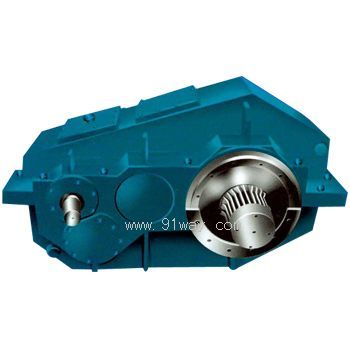
The QY series reducers include two series of hard toothed reducers for cranes: the QYS type (three pivot point) and the QYD type (base type). It has three types: three-level, four level, and three four level combination. The structural diagram is shown in Figure 1
This reducer is mainly used for various related mechanisms of cranes. It can also be used for the transmission of mechanical equipment in transportation, metallurgy, mining, chemical and light industry industries. Its working conditions are:
1) Gear circumferential speed not exceeding 20m/s:
2) The high-speed shaft speed shall not exceed 1500r/min;
3) The working environment temperature is -40 ℃ -+45 ℃;
4) Can operate in both directions.
2. Performance characteristics:
Considering the working characteristics, transmission ratio range, and further improvement of product performance of each mechanism of the crane, fewer specifications are adopted to meet the diverse requirements of users. Its characteristics are:
1) High carrying capacity. The gear adopts carburizing, quenching, and grinding processing, and its load-bearing capacity is significantly improved compared to the soft tooth surface and medium hard surface gear reducers with quenched and tempered rolling teeth.
2) Small size and light weight. Compared with reducers with soft and medium hard tooth surfaces, reducers with the same load-bearing capacity can reduce the equivalent machine base size by 2-4.
3) High efficiency, low noise, and minimal vibration. The use of gear grinding has improved the accuracy level. The gears have also been trimmed. The comprehensive efficiency of each gear stage is 0.98. Vibration and noise have been significantly reduced.
4) By using multiple levels and reducing the single-stage speed ratio, the center distance can be widened and the overall height of the reducer can be reduced to meet the requirements of various mechanisms of the crane; The maximum nominal transmission ratio of the reducer reaches 400, which meets the requirements of slow speed cranes.
5) The three-point reducer can be installed vertically, horizontally, or even at a certain angle of deflection, making it convenient and flexible.
6) This series of reducers has a three-level combination type (i.e. a three-level assembly type with a four level transmission ratio), which provides a prerequisite for the generalization of slow speed cranes.
3. Assembly type
The two series of reducers have the same assembly type, as shown in Figure 2
4. Installation type
The QYS type reducer can be installed in horizontal (W), vertical (L), or with a deviation of ± α angle. Pay attention to the oil immersion height to ensure good lubrication. See Figure 3
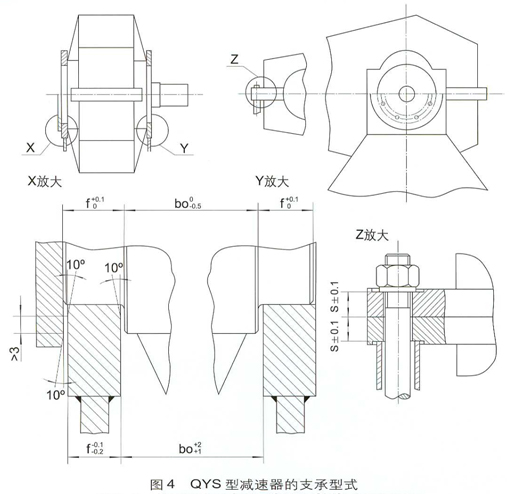
The support type of QYS reducer is shown in Figure 4
5. Shaft end type
The high-speed shaft end adopts cylindrical shaft extension and flat key connection.
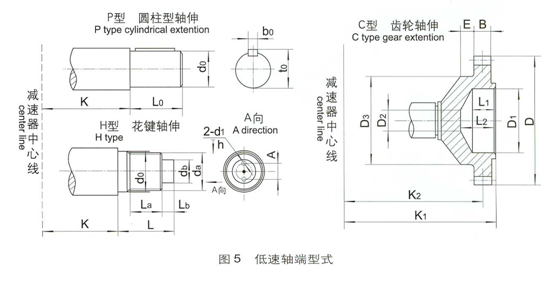
There are three types of low-speed shaft ends:
a. P-type: cylindrical shaft extension, flat key, single key connection;
b. H-type: cylindrical shaft extension, involute spline connection;
c. Type C: Gear shaft end (only reducers with nominal center distance of 180-560mm have gear shaft end). The type and size of the low-speed shaft end are shown in Figure 5
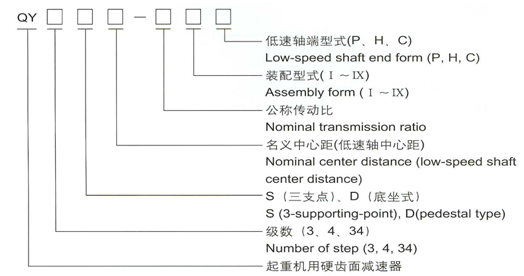
6. Model and Marking

 Your location:Home → mechanical transmission → speed reducer → Stepless gearbox → QY series crane reducer

 Zoom in on the image
 Related Products:
 100CJ01,130CJ01 type gear reducer
 speed reducer
  Belt reducer
 沪公网安备31010702003255号
