
 |
Product name: | Z560 type DC motor | |||||
| specification: |   Zoom in on the image Zoom in on the image |
||||||
| Category: | motor products -- Small-medium DC motors | ||||||
| |
Price: | factory price | |||||
| Brand: | Shanghai | ||||||
| Place of Origin: | China | ||||||
| |
Available Quantity: | batch | |||||
| delivery cycle: | Spot goods (or inquire by telephone) | ||||||
 |
|
||||||
|
Percentage of base velocity |
Percentage of rated current | |
|
percentage of basic speed | ||
|
percentage of basic speed |
occasionally use |
frequently used |
|
seldon using |
constantly using | |
|
one hundred |
two hundred |
one hundred and seventy-five |
|
two hundred |
one hundred and sixty |
one hundred and fifty |
|
over 300 |
one hundred and forty |
one hundred and twenty-five |
|
Percentage of base velocity |
Percentage of rated current | |
|
percentage of basic speed | ||
|
percentage of basic speed |
occasionally use |
frequently used |
|
seldon using |
constantly using | |
|
one hundred |
200(180*) |
175(160*) |
|
two hundred |
160(180*) |
one hundred and sixty |
|
over 300 |
175(160*) |
one hundred and forty |
|
*When the base speed of the motor is greater than 650r/min, use the value in parentheses. | ||
|
*:When the basic speed of the motor≥650r/min,using the number in the bracket. | ||
c) Occasional short-term overload capacity refers to the ability of an electric motor to withstand a continuous rated load for more than 1 minute in rare or emergency situations. It is recommended to set the instantaneous breaking device of the circuit breaker according to the occasional short-term overload capacity; The commonly used short-term overload capacity refers to the ability of an electric motor to repeatedly withstand loads exceeding its continuous rated load during a portion of its normal operating cycle.
After short-term overload operation, the motor must be operated with light load to ensure that the root mean square value of the load throughout the entire load cycle does not exceed its continuous rating.
d) The second type of DC motor (Class B) should be able to withstand the following continuous loads:;
Continuous operation with 115% rated power load within the rated voltage and rated speed range, resulting in higher temperature rise under this load. Other characteristics may differ from the regulations for operation under rated conditions.
Within the rated voltage and rated speed range, after continuous operation at rated load, continue to operate at 125% rated power load for 2 hours, and the temperature rise shall not exceed the specified value. Other characteristics may differ from the regulations for operation under rated conditions.
e) The second type of DC motor (Class B) is allowed to overload up to 2.5 times during occasional use at rated speed, with a time not exceeding 15 seconds (but needs to be negotiated with the manufacturer)
5. Current change rate
At all speeds and loads, the current change rate (di/dt) that the motor can withstand is allowed to reach 250 times the rated current per second.
6. Vibration and noise
a) The vibration of the electric motor complies with the provisions of the central standard GB10068 "Measurement, Evaluation and Limits of Mechanical Vibration of Motors with Shaft Center Height of 56mm and Above".
b) The noise of the electric motor complies with the provisions of GB1069.3 "Methods and Limits for Noise Determination of Rotating Electrical Machines" standard.
The efficiency values in the technical data sheet refer to the efficiency of rated power, rated voltage, and rated speed, including excitation losses.
Capacity selection of electric motor
1. Class 1 (Class A): Ordinary industrial DC motors
The detailed data of this type of motor can be found in the technical data sheet, and users can determine the capacity, voltage, speed, and cooling method of the motor according to their needs.
2. Class 2 (Class B): DC motors for metal rolling mills
The rated output power of this type of motor is about 20% lower than the value in the technical data sheet of Class A motors, and the specific value will be agreed upon by the user and the manufacturer.
3. In addition to the specifications listed in the technical data sheet, the manufacturer can derive other specifications based on specific requirements raised by the user.
Model Description: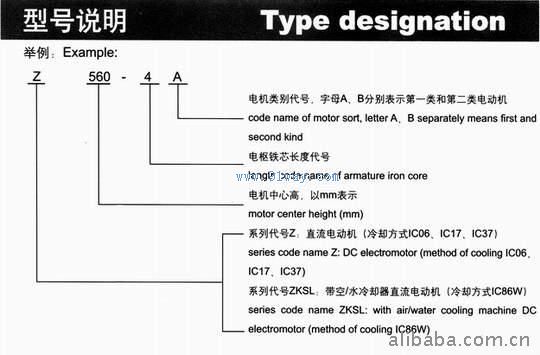
Structure Introduction:
1. Cooling method and protection level of electric motor
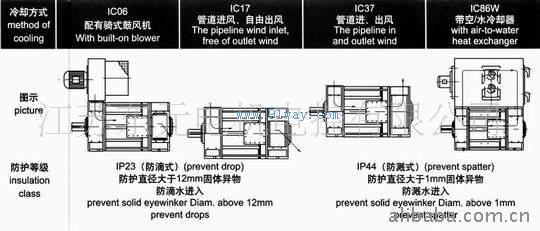
a) The cooling method for electric motors is external cooling. According to the GB/1993 "Cooling Methods for Rotating Electrical Machines" standard, there are four types: IC06, IC07, IC37, IC86W, etc. The standard type of cooling air inlet is located at the main drive end (non commutator end) of the motor. The protection level of the motor is divided into two types according to the GB/T4942.1 "Classification of Protection for Rotating Electrical Machinery Enclosures (IP Code)" standard: IP23 and IP44. If users require other cooling methods and protection levels, they can negotiate separately.
b) The corresponding relationship between the cooling method and protection level of the electric motor is shown in Table 1.
Table 1
c) The required cooling air volume, air pressure, cooling water flow rate, and fan motor power for the electric motor are shown in Table 2.
Table 2
|
base |
Riding type blower |
Air/water cooler | |||||
|
Frame |
built-on blower |
air-to-water heat exchanger | |||||
|
Cooling air volume |
Wind pressure (static pressure) |
Electric motor power* |
weight |
cooling water flow rate |
Electric motor power* |
weight | |
|
cooling wind |
wind pressure (whisht pressure) |
motor power |
wight |
cooling water flux |
motor power |
wight | |
|
m3/hr |
Pa |
kW |
kg |
m3/hr |
kW |
kg | |
|
H500 |
ten thousand |
one thousand and nine hundred |
seven point five |
three hundred |
nineteen |
eleven |
nine hundred |
|
H560 |
sixteen thousand and five hundred |
two thousand two hundred and fifty |
fifteen |
four hundred |
twenty-two |
eighteen point five |
one thousand and one hundred |
|
H710 |
twenty-three thousand and five hundred |
two thousand and four hundred |
eighteen point five |
six hundred |
forty |
2×11 |
one thousand and six hundred |
 Related Products:
 DK-1A series reversible DC motor J180ZWX12 type brushless DC motor J130ZWX06-Z type brushless DC motor J120ZWX07-Z,J120ZWX10-Z type brushless DC mot.. J120ZWX05,120ZWX06-Z type brushless DC motor .. J110ZWX10-Z type brushless DC motor J110ZWX-J01 type brushless DC motor J100ZWX10ZZ type brushless DC motor J100ZWX08-X-Z type brushless DC motor J100ZWX02 type brushless DC motor Related articles:
 generator
  high-voltage motor synchronous motor DC motor Small-medium DC motors
  Permanent magnet DC motor DC brushless motor DC deceleration motor DC traction motor DC brake motor DC variable frequency motor Special DC motor asynchronous motor Special motor servo motor Transportation motor Speed motor single-phase motor stepper motor synchro torque motor coreless motor motor driver motor speed controller encoder
 Home|Quality Commitment|Ordering|Payment method|product delivery|support|Disclaimer|Contact Us
Copyright®2011 www.91way.com Copyright.
Phone:+86-21-66770508 +86-13916500500 Fax:+86-21-66108310
Email:91way@163.com Wechat:40606422
沪ICP备2021005791号  沪公网安备31010702003255号
 Your location:
