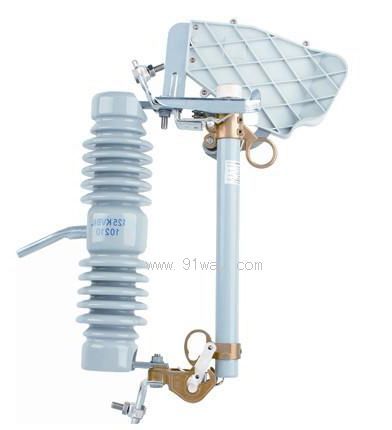
The RNCX type drop out fuse is a gas injection type distribution network fuse, whose main function is to provide protection for equipment on the distribution line that may be damaged due to fault current or overcurrent. Capable of meeting load current and capacitor current, designed and tested according to standards such as GB 15166.3, IEC 282-2, ANSI C37-41, NEMA SG2, etc.
Rated parameters of RNCX-15F drop out fuse:
The rated parameters of a fuse are rated operating voltage, rated short-circuit breaking current, and continuous operating current.
Rated voltage: represented by the line to line voltage of the system, i.e. single voltage representation (such as 12kV). The modified fuse can be applied in systems where the line voltage does not exceed the rated voltage. The base (or insulator) of the fuse shall be classified according to the rated BIL. The rated value is marked on the side of the porcelain sleeve (see Figure 1-9).
The nameplate on the melting tube indicates the rated voltage, rated current, and rated short-circuit breaking current parameters, which depend on the form of equipment ordered. Users can only use it correctly within the specified rated parameters.
Rated short-circuit breaking current: the maximum symmetrical fault current that can be successfully broken by a fuse at rated voltage. This parameter is marked on the nameplate together with the rated voltage.
Rated continuous current: The maximum rated current of the base of the RNCX fuse is 300A, and the fuse tube is divided into 100A and 200A.
12KV-15KV
|
model
Type |
rated
voltage
Rated
Volage
(kV) |
rated
current
Rated
Current
(A) |
Disconnect
current
Breaking
Current
(A) |
impact
voltage
Impulse
Volage
(BIL) |
power frequency withstand voltage
Power-
frequency
withstand
Voltage
(kV) |
creepage distance
Leakage
distance
(mm) |
weight
Weight
(kg) |
packing ruler
Inch assembly
Dimensions
(cm) |
|
RNCX-15F |
fifteen |
one hundred |
six thousand and three hundred |
one hundred and twenty-five |
forty-five |
three hundred and thirty |
eight point five |
61×35×16 |
|
RNCX-15F |
fifteen |
two hundred |
twelve thousand and five hundred |
one hundred and twenty-five |
forty-five |
three hundred and thirty |
nine |
RNCX-15F drop out fuse structure:
The structure of the fuse allows the use of GB standard fuses and pressure relief caps. The melting tube can be removed or inserted into the base by hook rod operation. An isolation knife can be used to replace 100A or 200A fuse tubes, thereby turning the fuse into a 300A isolation switch, and vice versa. The isolation switch can also be operated with a hook rod.
Fuses can be equipped with standard mounting brackets. Can be installed on standard columns. Pay attention to the installation angle.
4、 Operation:
Drop out fuses are high-voltage equipment that are typically operated using standard specialized tools. And attention should be paid to the correctness and safety of the operation. Use a hooked rod to pull and push the hook and loop of the melting tube (Figure 1) to complete the opening and closing operation. The opening and closing operation requires fast and stable operation to reduce the burning damage of the contact (Figure 1-2) caused by arcing. (Note: Operation safety regulations must be followed when operating any equipment)
If the drop type RNCX uses the S&C load disconnect tool, it can be used as a load disconnect device. RNCX is equipped with hooks that meet mechanical and electrical requirements (Figure 1-11). The rated load breaking parameters displayed on the nameplate of the load breaking tool indicate its function and its ability to cut loads under given circuit conditions. At the same time, confirm that the rated voltage parameters on the tool nameplate are consistent with the system voltage. To use the disconnect tool correctly and safely, please refer to the instruction manual or operating procedures that come with the disconnect tool.
Before putting the fuse into use, any obvious damage should be visually inspected, such as bent components or broken porcelain bushings (Figure 1-10) during transportation. At the same time, check the alignment between the melting tube and the base.
5、 When using GB standard fuses to reinstall the melting tube, attention should be paid to:
1) When using a used melting tube, it is necessary to check and confirm whether there are enough fibers left inside the melting tube to complete the cutting fault operation. The fuse installed with a fuse will burn the fibers inside the melting tube during continuous operation, thereby increasing the inner diameter of the melting tube.
If the inner diameter of the melting tube is greater than the following dimensions, it must be replaced:
100A melting tube, 0.65 "(16.5mm) 12.5kV/100A melting tube, 0.9" (23mm)
200A melting tube, 0.94 "(24mm)
2) Fuses of 100A and below can only be used in 100A fuse tubes. Fuses of 100A and below used for 200A melting tubes will result in serious consequences such as inability to disconnect due to overheating or low current faults.
3) The arc extinguishing tube, which is part of the fuse assembly, must not be bent or damaged before installation. Damaged melting pipes will result in the inability to disconnect small currents.
4) The pressure relief cap (Figure 1-4) should be fastened to the button head of the fuse to obtain the ideal current channel. Loose pressure relief caps can cause an increase in circuit resistance, leading to overheating or melting of fuses.
5) The fin shaped ejection plate (Figure 1-5) increases the tension of the fuse and is used to assist in the ejection of the fuse. For this, it should be locked behind the cast iron ring and pressed down by a fuse. Pull out the fuse with force (it can withstand a tensile force of about 44N), wrap the tap clockwise on the bolt, and press it under the compression nut, which has a torque of 13-20N. m. The remaining part of the tap should be cut off.
6) The pressure relief cap cannot be reused. When the fuse cuts off the fault, the top of the pressure relief cap will be broken, and it will no longer be able to secure the top button of the fuse. The components that need to be replaced are limited to caps, fuses, and fuses.
7) Although drop out fuses are designed for outdoor use, do not keep the fuse tube in a constantly open state. In this way, the opening of the melting tube is upward, which makes it easy for water to accumulate in the tube, causing the fibers to expand and leading to failure during disconnection.
8) The contacts of the fuse are silver plated and coated with a protective layer of silicone grease. Old silicone grease and accumulated dust should be cleaned up in a timely manner. The protective layer can be renewed by applying a thin layer of silicone grease. When dealing with severe natural corrosion, fine sandpaper can be used to polish the contacts. It is not recommended to use sharp metal tools as they may damage the silver plating layer.
6、 Open the box
Drop out fuses are packaged and transported in thick cardboard boxes. Be careful to avoid damaging the equipment during unboxing and installation.
Insulators are wet manufactured porcelain insulators, which are very sturdy but can also break when they come into contact with sharp objects. Once broken, it may lead to unreliable electrical insulation. Please pay special attention and handle with care!

 Your location:Home → High voltage electrical appliances → High-voltage fuse → Drop out fuse → RNCX-15F Drop out fuse

 Zoom in on the image
 Related Products:
 WR3 series porcelain pillar drop out fuse
 high-voltage circuit breaker
  HV grounding switch
 沪公网安备31010702003255号
