
 Your location:Home → mechanical transmission → coupling → gear coupling → WGI,WGII Drum type Gear Coupling
 |
Product name: | WGI,WGII Drum type Gear Coupling | |||||
| specification: |   Zoom in on the image Zoom in on the image |
||||||
| Category: | mechanical transmission -- gear coupling | ||||||
| |
Price: | factory price | |||||
| Brand: | Shanghai | ||||||
| Place of Origin: | China | ||||||
| |
Available Quantity: | batch | |||||
| delivery cycle: | Spot goods (or inquire by telephone) | ||||||
 |
|
||||||
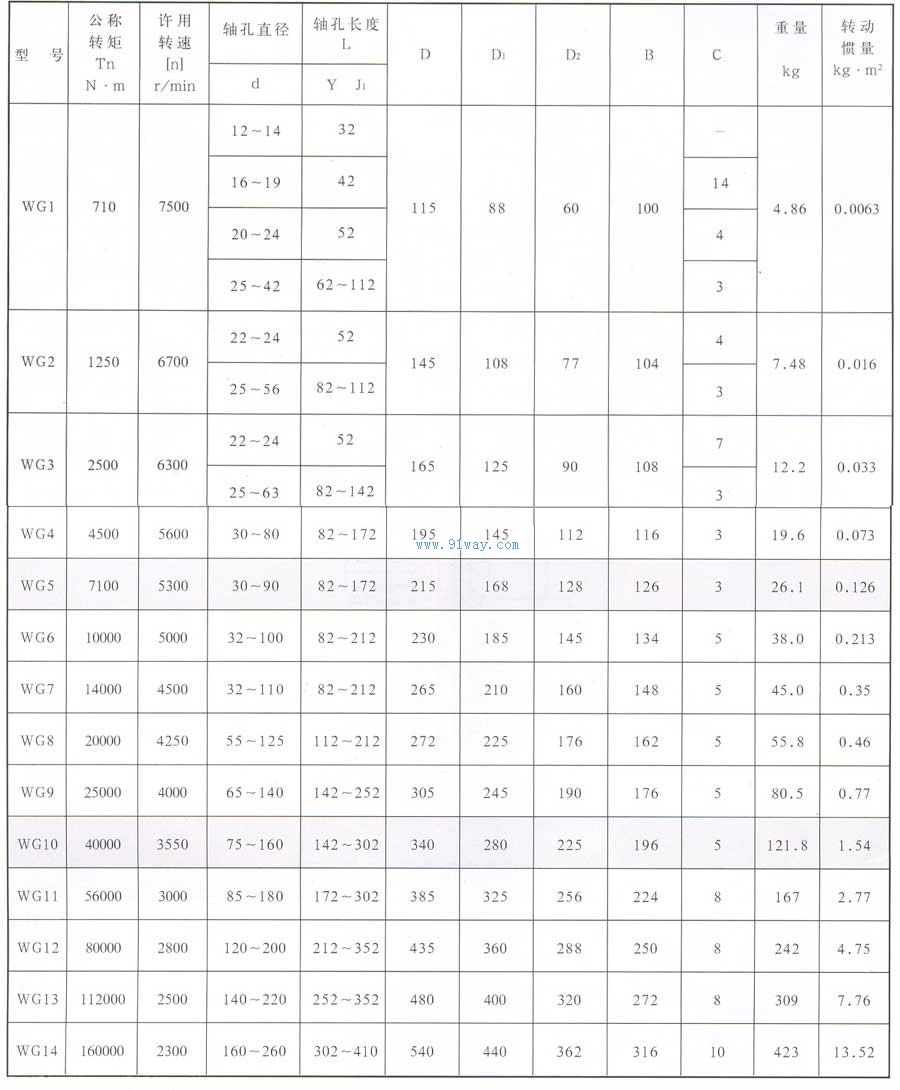
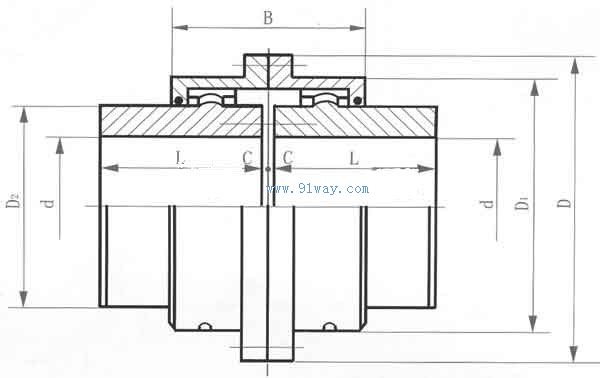
WG II Drum Gear Coupling (JB/ZQ4186-9)
Drum type gear coupling belongs to rigid flexible coupling, which is composed of internal gear rings with the same number of teeth and flange half couplings with external teeth. External teeth are divided into two types: straight teeth and drum teeth. The so-called drum teeth refer to the outer teeth being made into a spherical surface, with the center of the spherical surface on the gear axis and a larger tooth clearance than general gears. Drum tooth couplings can allow for larger angular displacement (compared to straight tooth couplings), improve tooth contact conditions, enhance torque transmission ability, and extend service life. The contact state along the tooth width when there is angular displacement. It has the ability to compensate for radial, axial, and angular axis deviations, and has the advantages of compact structure, small turning radius, large bearing capacity, high transmission efficiency, low noise, and long maintenance cycle. It is particularly suitable for low-speed and heavy-duty working conditions, such as metallurgy, mining, lifting and transportation industries, as well as shaft transmission for various types of machinery such as petroleum, chemical, and general machinery.
When the toothed coupling is in operation, the two shafts produce relative angular displacement, and the tooth surfaces of the inner and outer teeth periodically slide axially relative to each other, inevitably resulting in tooth surface wear and power consumption. Therefore, the toothed coupling needs to work in a good and sealed state. Gear couplings have small radial dimensions and high load-bearing capacity, and are commonly used for shaft transmission under low-speed heavy load conditions. High precision and dynamically balanced gear couplings can be used for high-speed transmission, such as shaft transmission in gas turbines. Due to the greater angular compensation of drum shaped gear couplings compared to straight toothed couplings, drum shaped gear couplings are widely used both domestically and internationally. Straight toothed couplings are a product that has been phased out and should be avoided as much as possible.
Characteristics of WGI and WGII drum type gear couplings (compared to spur gear couplings, they have the following features):
1. Strong carrying capacity. Under the same outer diameter of the inner gear sleeve and the maximum outer diameter of the coupling, the load-bearing capacity of the drum shaped coupling is on average 15-20% higher than that of the straight toothed coupling.
2. The angular displacement compensation amount is large. When the radial displacement is equal to zero, the allowable angular displacement of the spur gear coupling is 1o, while the allowable angular displacement of the drum gear coupling is 1o30 ', an increase of 50%. Under the same modulus, number of teeth, and tooth width, drum shaped teeth allow for greater angular displacement than straight teeth.
3. The drum shaped tooth surface improves the contact conditions between the inner and outer teeth, avoiding the drawbacks of edge compression and stress concentration of straight teeth under angular displacement conditions. At the same time, it improves the friction and wear of the tooth surface, reduces noise, and has a long maintenance cycle.
4. The outer gear sleeve has a trumpet shaped tooth end, making it very convenient to assemble and disassemble the inner and outer teeth.
5. The transmission efficiency is as high as 99.7%.
Based on the characteristics of the past, drum teeth have been widely used to replace spur gear couplings both domestically and internationally.
WGI drum type gear coupling
 Related Products:
 YOXJ series hydraulic coupling NL type nylon internal gear coupling ROTEX-GR type star shaped coupling elastic bo.. SOWM,SOWF series coupling capacitors for test.. DL type multi angle coupling 10-35KV Integrated Capacitive Coupling Device.. L105CH Coupling type centrifugal clutch L90CH Coupling type centrifugal clutch L65CH Coupling type centrifugal clutch L41CH Coupling type centrifugal clutch Related articles:
 speed reducer
  conveyor elevator gearbox divider backstop Brake | Clutch buffer shock absorber drive belt drive wheel drive shaft coupling Slider coupling Roller coupling Flexible coupling Flange coupling safety coupling diaphragm coupling gear coupling
  Rigid coupling Spring coupling Flexible Coupling pin coupling Chain coupling Clamp shell coupling Tyre coupling universal joint Encoder coupling Bellows coupling expansion sleeve Chain wheel chain motor bearing motorized roller industrial remote control
 Home|Quality Commitment|Ordering|Payment method|product delivery|support|Disclaimer|Contact Us
Copyright®2011 www.91way.com Copyright.
Phone:+86-21-66770508 +86-13916500500 Fax:+86-21-66108310
Email:91way@163.com Wechat:40606422
沪ICP备2021005791号  沪公网安备31010702003255号

