
 Your location:Home → motor products → asynchronous motor → Communication brake motor → YEJAK series AC electromagnetic braking three-phase asynchronous motor
 |
Product name: | YEJAK series AC electromagnetic braking three-phase asynchronous motor | |||||
| specification: |   Zoom in on the image Zoom in on the image |
||||||
| Category: | motor products -- Communication brake motor | ||||||
| |
Price: | factory price | |||||
| Brand: | |||||||
| Place of Origin: | China | ||||||
| |
Available Quantity: | batch | |||||
| delivery cycle: | Spot goods (or inquire by telephone) | ||||||
 |
|
||||||
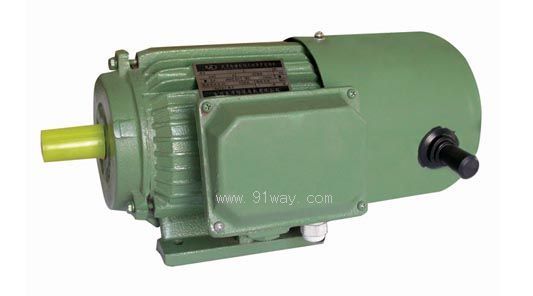
The YEJAK series AC electromagnetic braking three-phase asynchronous motor is a novel AC braking motor carefully designed according to the requirements of the national standard JB/T 6456. It is composed of a Y series standard motor and an AZMK AC brake. It has the characteristics of fast dynamic response (from static to power on opening time) and short braking time, which is half the time faster than the usual DC brake. It can be widely used in various transmission machinery that requires fast braking and accurate positioning. Such as elevators, conveyors, packaging machinery, printing machinery, food machinery, and supporting reducers used in various transmission machinery and equipment.
The structural characteristics of YEJAK series AC electromagnetic brake three-phase asynchronous motor:
1. The installation size and power level comply with the Y series standard and the international IEC 72 standard;
2. The protection level of the motor body is IP44, and the AC brake is IP23;
3. The insulation level of the motor is Class B, and the brake is Class F;
4. Manual release has self-locking function, making it flexible and convenient to use;
5. The AC brake directly uses a three-phase AC power supply without intermediate rectification conversion.
YEJAK series AC electromagnetic brake three-phase asynchronous motor usage conditions:
1. Altitude not exceeding 1000m;
2. Rated voltage 380V 50Hz (AC brake and motor are the same);
3. Working mode S1 (continuous work system);
4. The maximum ambient temperature shall not exceed 40 ℃, the minimum shall be -15 ℃, and the relative humidity shall be ≤ 90%.
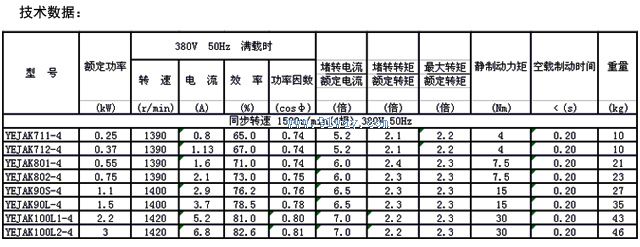
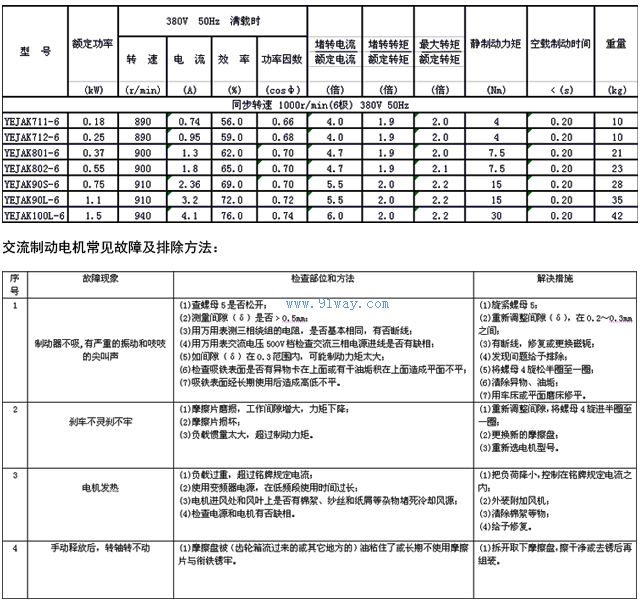
Wiring method:
1. Single junction box (regular supply)
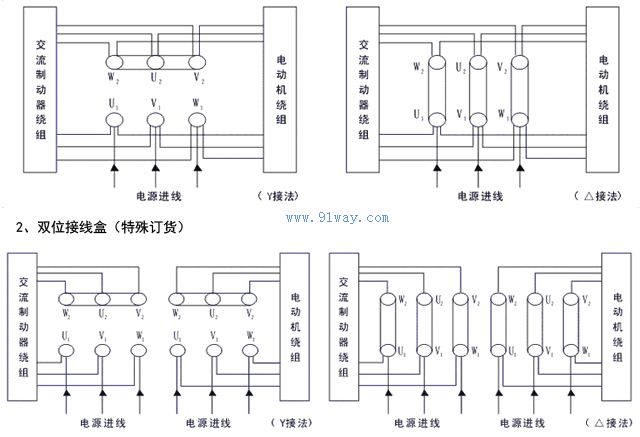
Note: The electric motor and brake must be powered on simultaneously.
Inspection and adjustment of gaps:
The distance between the armature plate and the electromagnet is called the gap (δ). The normal working clearance (δ) is controlled within 0.2-0.3mm, with a maximum of 0.5mm. The motor is adjusted within the normal working clearance range when it leaves the factory. After running for a period of time, the clearance value increases due to friction plate wear. If it exceeds the maximum clearance, it will affect the normal suction and braking of the AC brake and must be adjusted.
Adjustment method: Prepare a set of thick and thin feeler gauges, select 0.25mm pieces, first measure at the gap (δ) position (three screw orientations) shown in Figure 1. If it has exceeded, loosen nut 5, place the 0.25mm feeler gauge into the gap (δ) of the loosened screw, slowly screw in safety nut 7, tighten the feeler gauge, then tighten nut 5 outward and pull out the feeler gauge. Adjust the gap between the second and third screws using the same method, and then tighten nut 5 again. Nut 5 must be tightened and checked regularly to ensure it is not loose.
If there is no regular feeler gauge, a similar thickness of iron sheet can be used as a substitute. The safety nut 7 moves forward by about 0.15mm every 60 ° rotation (hexagonal nut divided into six equal parts). The three points of gap adjustment must be uniform, otherwise it will affect the brake suction and braking, and in severe cases, it may burn out the coil.
Adjustment of torque:
When the motor leaves the factory, the torque has been adjusted to the standard value. After using the motor for a period of time, due to the wear of the friction plate, the brake spring is slightly relaxed, and the braking torque relatively decreases slightly. If the use does not have a significant impact, it can be left stationary. If you feel a decrease in torque and need to increase the braking torque, you can evenly rotate the three safety nuts 4 forward by about 180 ° (about half a turn), at most one turn, not too much. Due to the large braking torque, it may cause difficulty in engagement or make unpleasant squeaking electromagnetic sounds, and in severe cases, it may burn out the coil. If the braking torque needs to be reduced, loosen the safety nut 4 backwards by 180 ° (half a turn), at most one turn, otherwise the torque will be too small. Regardless of whether the torque is adjusted small or large, the clearance needs to be readjusted.
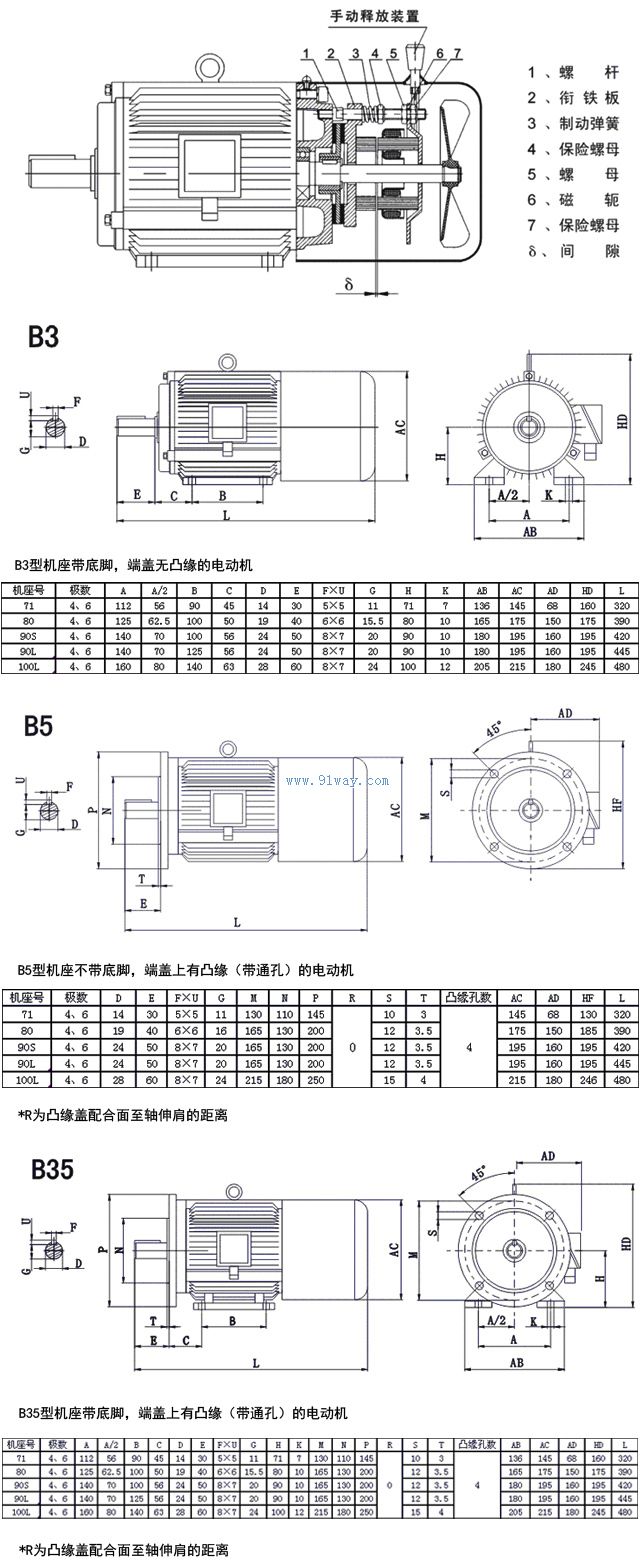
YEJAK series AC electromagnetic brake three-phase asynchronous motor
 Related Products:
 YX3EJ series electromagnetic braking three-ph.. FEJS type electromagnetic braking three-phase.. YXEJ series electromagnetic braking three-pha.. YEJ2-T/X Electromagnetic Braking Three Phase .. YUEJ,MYUEJ series electromagnetic braking thr.. YEW,YEWS Series Stage Machinery Special Elect.. YZER series electromagnetic braking three-pha.. YBZSE series explosion-proof dual speed elect.. YEJA series AC electromagnetic braking three-.. YEJK series electromagnetic braking three-pha.. Related articles:
 generator
  high-voltage motor synchronous motor DC motor asynchronous motor Split horsepower motor Small-medium asynchronous Multi pole variable speed motor AC variable frequency motor Communication reduction motor Communication brake motor
  Communication specific motor Special motor servo motor Transportation motor Speed motor single-phase motor stepper motor synchro torque motor coreless motor motor driver motor speed controller encoder
 Home|Quality Commitment|Ordering|Payment method|product delivery|support|Disclaimer|Contact Us
Copyright®2011 www.91way.com Copyright.
Phone:+86-21-66770508 +86-13916500500 Fax:+86-21-66108310
Email:91way@163.com Wechat:40606422
沪ICP备2021005791号  沪公网安备31010702003255号

