
 Your location:Home → low-voltage electrical apparatus → relay → time relay → SSJ-42A type static time relay
 |
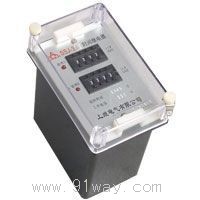
Product name: | SSJ-42A type static time relay | |||||
| specification: |   Zoom in on the image Zoom in on the image |
||||||
| Category: | low-voltage electrical apparatus -- time relay | ||||||
| |
Price: | factory price | |||||
| Brand: | |||||||
| Place of Origin: | China | ||||||
| |
Available Quantity: | batch | |||||
| delivery cycle: | Spot goods (or inquire by telephone) | ||||||
 |
|
||||||
I. Overview
1. Main purpose of the product
The SSJ series static time relay (hereinafter referred to as the relay) is used in the secondary circuit relay protection and automatic control circuit of the power system as an extension
Set the controlled component to obtain the required delay. This relay is an integrated circuit static relay with high precision, low power consumption, accurate action time, and intuitive setting
Convenient and wide range, the working power supply adopts switch power conversion, AC/DC universal, and can completely replace electromagnetic time relays.
2、 Classification and meaning of relay models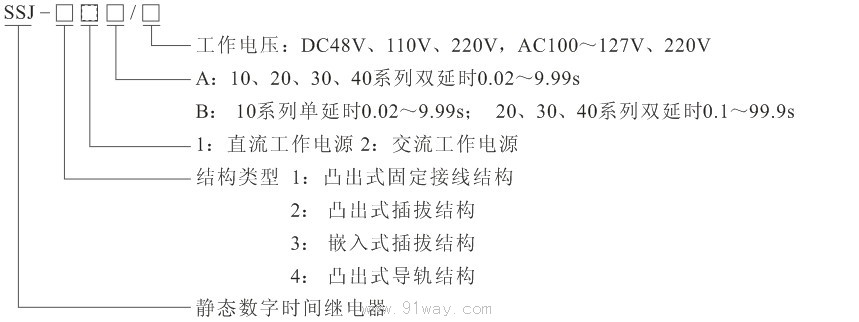
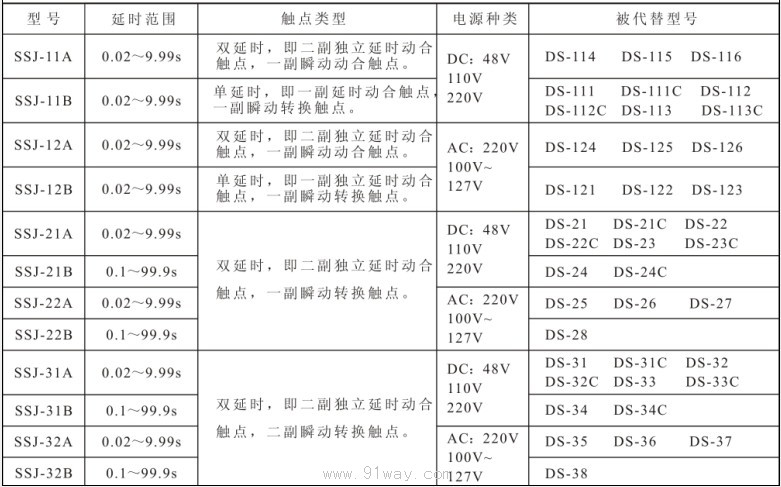
Comparison Table of SSJ-421A Static Time Relay Models and Replaced Old Models:
3、 Product composition and working principle
1. This relay has a much higher delay accuracy than the DS type electromagnetic time relay, which can meet the requirements of shortening the protection time difference in power system relay protection. It is currently an ideal replacement product for time relays. The external structure, internal wiring, working mode, and setting range of this relay are the same as those of the DS series time relay, except for the setting mode. The setting time is calculated by multiplying the three digits of the dip switch by the 0.01s or 0.1s time base. Changing the setting value does not require verification.
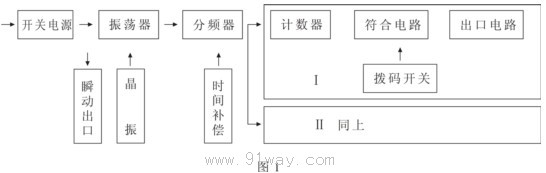
2. This relay is an action delay digital time relay composed of imported CMOS integrated circuits. The relay consists of an oscillator, a frequency divider, and a three-stage pulse counter, and the delay value is set through a BCD code dip switch.
3. Relays are usually not charged. After applying the rated voltage, the internal instantaneous relay of the relay acts and the crystal oscillator starts oscillating, generating clock pulses. After frequency division, the number of pulses is counted by the counter. When the counted number of pulses reaches the delay setting value, the trigger flips and drives the output relay to act, achieving the required delay. Due to the use of a crystal oscillator and the addition of a time compensation preset circuit, it strictly meets the setting value for extremely short delay values and has extremely high accuracy.
4. The dual delay loop of the relay has relatively independent delays and drives one executing relay each. Therefore, the dynamic closing contacts of the two executing relays can be used as termination and sliding contacts of the relay according to the length of the delay. However, after the sliding contacts are closed, their closed state remains until the relay loses power and returns
The customer needs to return immediately after the sliding contact is closed for a certain period of time. When placing an order, it is necessary to specify and provide the duration of the sliding contact's closure.
5. The schematic diagram of SSJ-421A static time relay is shown in Figure 1.
4、 Technical requirements
1. The rated values and specifications are shown in the table above.
2. Delay accuracy
a、 Average error of delay setting value: Under reference conditions, the absolute value of the average error of relay delay setting value shall not exceed 0.1%+3ms of the setting value;
Average error=(average of 5 measurements - set value)/set value x 100%.
b、 Delay consistency: Under benchmark conditions, the delay consistency of the relay is not greater than the set value (3-10ms).
c、 At temperatures ranging from -10 to 50 ℃, the absolute value of the average error (including consistency) of any delay setting value shall not exceed 0.1%+5ms of the setting value.
3. Working voltage: When the operating voltage is not greater than 70% of the rated voltage, the relay should work reliably.
4. Return time of relay
The time for the outlet contact to return to the starting position after cutting off the electrical power supply should not exceed 25ms for varieties that use DC power supply.
5. Return voltage of relay
When the voltage of the relay is reduced by no less than 10% of the rated voltage, the relay contacts should reliably return.
6. Power consumption
DC48V, Not exceeding 2W;
DC110V or AC100-127V, not exceeding 4.5W (6.5VA)
DC or AC220V, not exceeding 8.1W (13VA).
7. Thermal performance requirements
This series of relays can operate for a long time when powered on, and can withstand 1.1 times the rated voltage value for a long time when the ambient temperature is 50 ℃.
8. Power supply working characteristics: The power supply can slowly rise and fall, suddenly turn on/off, or supply power through shaking contacts. The relay can work normally and there is no zero second outlet or instantaneous outlet phenomenon.
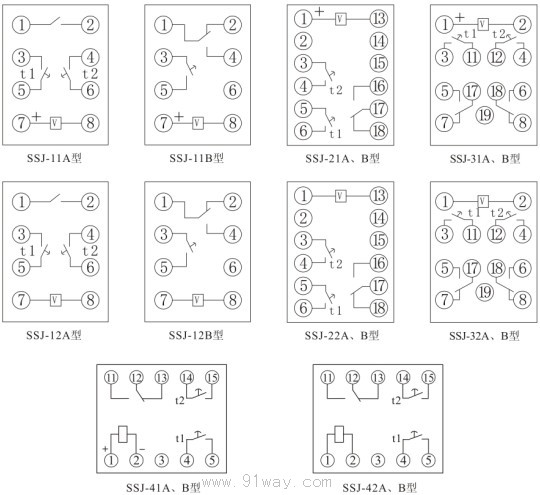
5、 Internal wiring (front view)
6、 Appearance and opening size
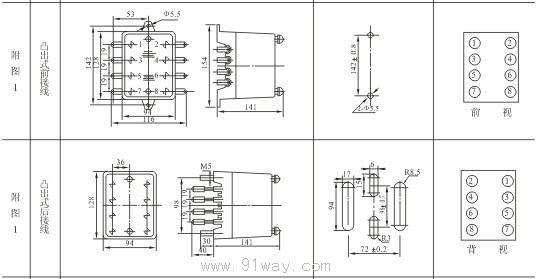
SSJ-10 adopts a protruding fixed structure, and the appearance and installation hole size are detailed in Figure 1
The SSJ-20 adopts a protruding plug-in structure, and the appearance and installation hole size are detailed in Figure 2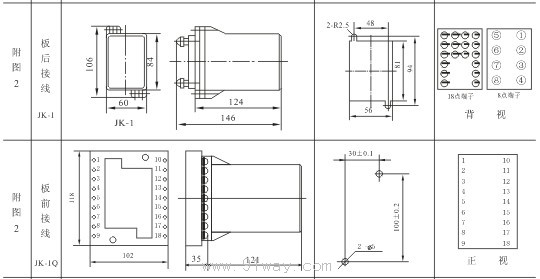
SSJ-30 adopts an embedded insertion structure, and the appearance and installation hole size are detailed in Figure 3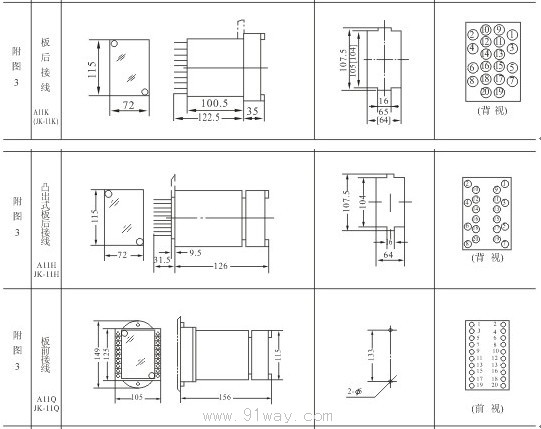
SSJ-40 adopts a protruding guide rail structure, and the appearance and installation hole size are detailed in Figure 14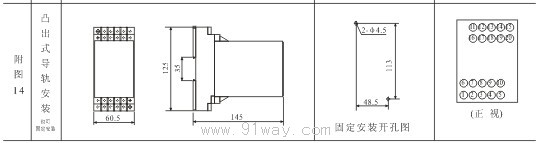
 Related Products:
 SHZ1(ST8) Intelligent Dual Digital Time Relay.. SHZ8,SHZ8-1 Time Relay SH72,SH96-96 Preset digital display time rela.. ST9,SH3D Ultra small Pull out Time Relay SH3,ST3 Time Relay SH36 Ultra small time relay JS-11AG Rail type time relay XMT7000J Intelligent time relay ASY-2SM/3SM Digital Time Relay JS14C Preset digital display time relay Related articles:
 low-voltage circuit breaker low-voltage contactor Low voltage transformer relay
  thermal relay Temperature relay time relay
  Universal relay intermediate relay power relay current relay overcurrent relay voltage relay signal relay Flash relay Differential relay Impact relay Position relay Frequency relay Phase relay Locking relay pressure relay gas relay Coaxial relay Polarized relay automotive relay Leakage relay Phase failure relay solid state relay electromagnetic relay Explosion proof relay Module relay Other relays Relay socket Reclosing relay Acceleration relay Power direction relay Synchronous grounding relay Insulation monitoring relay Counter | timer Low-voltage fuse starter electromagnet resistor Low-voltage arrester power capacitor Low voltage reactor dual power switch Low voltage isolator changeover switch Master Electrical Appliance terminal block plug socket electromagnetic chuck Electrotechnical equipment lighting distribution box Low voltage protector Electric cabinet door lock handle Building electrical appliances
 Home|Quality Commitment|Ordering|Payment method|product delivery|support|Disclaimer|Contact Us
Copyright®2011 www.91way.com Copyright.
Phone:+86-21-66770508 +86-13916500500 Fax:+86-21-66108310
Email:91way@163.com Wechat:40606422
沪ICP备2021005791号  沪公网安备31010702003255号

