
 Your location:Home → low-voltage electrical apparatus → relay → solid state relay → YJGX-4FD Single phase circuit board DC solid-state relay
 |
Product name: | YJGX-4FD Single phase circuit board DC solid-state relay | |||||
| specification: |   Zoom in on the image Zoom in on the image |
||||||
| Category: | low-voltage electrical apparatus -- solid state relay | ||||||
| |
Price: | factory price | |||||
| Brand: | |||||||
| Place of Origin: | China | ||||||
| |
Available Quantity: | batch | |||||
| delivery cycle: | Spot goods (or inquire by telephone) | ||||||
 |
|
||||||
|
single |
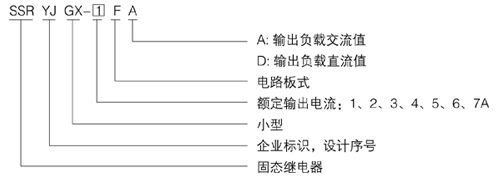
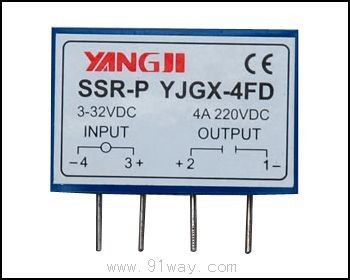
Product Model | YJGX-4FD | wiring diagram |
| Control method | Direct current controlled direct current (DC-DC) | 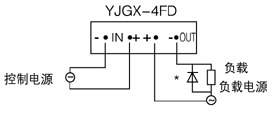 | |
| load current | 3A、4A | ||
| load voltage | 60VDC、110VDC、220VDC | ||
| control voltage | DC3-32V | ||
| control the current | 6-35mA | ||
| On state leakage current | ≤1.5mA | ||
| On state voltage reduction | ≤1.2V | ||
| Off state time | ≤10mS | ||
| Dielectric Strength | 1500VAC | ||
| insulation resistance | 500MΩ/500VDC | ||
| ambient temperature | -25℃-+70℃ | ||
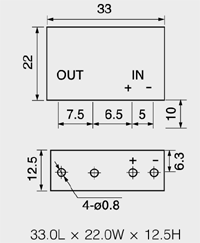
| Installation method | Printing layout PCB | ||
| weight | 16g | Note: When used for inductive loads, users must add suppression circuits |
Product application:
The SSR circuit board solid-state relay adopts a flame-retardant engineering plastic shell, epoxy resin encapsulation, single column direct insertion circuit board welding installation, and standard modular size. Compared with electromagnetic relays, it has no mechanical sound, no contact arcing, higher surge current tolerance, long service life, and high reliability.
The small driving current at the input end makes it convenient to interface with computer terminals and various digital programmable circuits, achieving weak power isolation and control.
Widely used in automation control fields such as petrochemical equipment, food machinery, packaging machinery, textile machinery, CNC machine tools, plastic machinery, fitness equipment, entertainment facilities, etc., it can control small motors, incandescent lamps, indicator lights, low-power power supplies, intelligent instruments and meters, and various solenoid valves. It can also be used as a driving stage for high-power electromagnetic contactors. Especially suitable for harsh environments such as corrosion, humidity, dust prevention, explosion-proof requirements, and frequent switching.
Safety precautions:
1. When used in AC inductive loads, high transient voltage and surge current are applied to the output terminal, which may cause the solid-state relay to conduct or be damaged. It is usually necessary to connect a voltage control device with a specific clamping voltage at the output terminal, such as a two-wire voltage regulator diode or a varistor (MOV). The recommended voltage for varistors is 1.6-1.9 times the rated voltage;
2. For DC inductive loads such as solenoids, electromagnets, and solenoid valves, a freewheeling circuit must be used to suppress the back electromotive force generated during shutdown. A simple method is usually to connect a diode in reverse parallel with the load, but this circuit will affect the release time of inductive loads such as electromagnetic relays, contacts, electromagnets, solenoid valves, etc. A better circuit is to connect a diode and a voltage regulator diode in reverse series or a diode and a resistor in series before connecting it in reverse parallel with the load.
3. When controlling a small current load close to the minimum load current, a virtual load resistor must be connected in parallel to the load to reduce the output leakage current and generate a higher residual voltage on the load.
4. When installing circuit board welding type relays, the welding temperature must be controlled below 260 degrees Celsius and the welding time must be controlled below 5 seconds.
5. In order to avoid the temperature rise of solid-state relays exceeding the allowable value, the design and application should consider the heat dissipation effect and installation position. When two or more solid-state relays are installed side by side, appropriate spacing should be left.
 Related Products:
 JGW-3023A,JGW-3026A Type Optical MOS Solid St.. JGC-3032,JGC-3033 Type Optical MOS Solid Stat.. JGC-3031,JGC-3031B Type Optical MOS Solid Sta.. JGC-3036,JGC-3036A Type Optical MOS Solid Sta.. JGC-3035,JGC-3035A Type Optical MOS Solid Sta.. JGW-3023B Type Optical MOS Solid State Relay .. JGW-3026B Type Optical MOS Solid State Relay .. JGC-3031A Type Optical MOS Solid State Relay .. JGC-3008 Type Optical MOS Solid State Relay JGW-3026 Type Optical MOS Solid State Relay Related articles:
 low-voltage circuit breaker low-voltage contactor Low voltage transformer relay
  thermal relay Temperature relay time relay Universal relay intermediate relay power relay current relay overcurrent relay voltage relay signal relay Flash relay Differential relay Impact relay Position relay Frequency relay Phase relay Locking relay pressure relay gas relay Coaxial relay Polarized relay automotive relay Leakage relay Phase failure relay solid state relay
  electromagnetic relay Explosion proof relay Module relay Other relays Relay socket Reclosing relay Acceleration relay Power direction relay Synchronous grounding relay Insulation monitoring relay Counter | timer Low-voltage fuse starter electromagnet resistor Low-voltage arrester power capacitor Low voltage reactor dual power switch Low voltage isolator changeover switch Master Electrical Appliance terminal block plug socket electromagnetic chuck Electrotechnical equipment lighting distribution box Low voltage protector Electric cabinet door lock handle Building electrical appliances
 Home|Quality Commitment|Ordering|Payment method|product delivery|support|Disclaimer|Contact Us
Copyright®2011 www.91way.com Copyright.
Phone:+86-21-66770508 +86-13916500500 Fax:+86-21-66108310
Email:91way@163.com Wechat:40606422
沪ICP备2021005791号  沪公网安备31010702003255号

