
 Your location:Home → low-voltage electrical apparatus → Electrotechnical equipment → Compensation equipment → TBBX Type High Voltage Motor Reactive Power Local Compensation Device
 |
Product name: | TBBX Type High Voltage Motor Reactive Power Local Compensation Device | |||||
| specification: |   Zoom in on the image Zoom in on the image |
||||||
| Category: | low-voltage electrical apparatus -- Compensation equipment | ||||||
| |
Price: | factory price | |||||
| Brand: | Shanghai | ||||||
| Place of Origin: | China | ||||||
| |
Available Quantity: | batch | |||||
| delivery cycle: | Spot goods (or inquire by telephone) | ||||||
 |
|
||||||
The TBBX type high-voltage motor reactive power local compensation device is connected in parallel with 3, 6, and 10kV high-voltage asynchronous motors to provide reactive current for excitation to the high-voltage motors, improve power factor, reduce the load on distribution transformers, reduce line and transformer losses, and enhance the efficiency of transformer and distribution equipment.
structural type
There are two structural types of on-site compensation devices for high-voltage asynchronous motors:
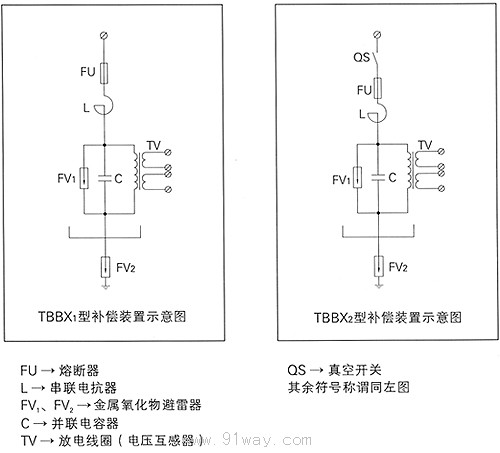
TBBX1 type
This device is fixedly connected to the motor and shares a switch for switching. The reactive current Ic of the capacitor in the device under operating voltage should not exceed the no-load current l0 of the motor.
TBBX2 type
This device can be separated from the electric motor, and the electric motor runs in parallel with this device during operation. When the motor is disconnected from the power grid, the device connected in parallel with the motor is also separated from the motor through a vacuum switch. In operation, the reactive current lc of the capacitor in the device can be greater than 10, but should not be greater than the reactive current required under the operating voltage of the motor,
L1 · Avoid reactive power backflow. The main wiring is shown in the following figure.
Meter installation
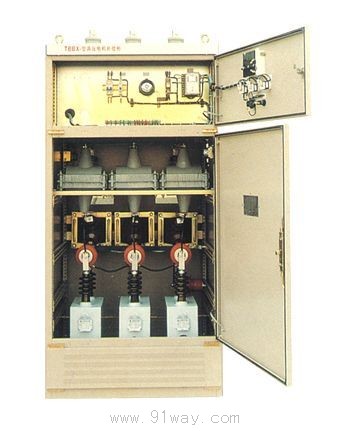
The device is equipped with live displays, electromagnetic locks, and can also be equipped with meters, alarms, etc. according to user requirements.
cabinet body
The device is a metal enclosed cabinet type, with the cabinet body grounded and the shell not electrified.
Performance characteristics
Correct compensation
According to the performance parameters of different motors, appropriate compensation capacity can be set to increase the power factor to above 0.90 and avoid overcompensation.
Limit current flow
When closing, the capacitor branch may generate multiple times the surge current. This device is equipped with a series reactor to limit the closing surge current within a safe range.
Set protection
To ensure the safe and reliable operation of capacitors, this device is equipped with the following protections:
Fuse protection
When a capacitor experiences inter electrode faults and pole to ground short circuits during operation, the fuse can reliably operate and the circuit breaker can be activated through a signaling device.
Open delta voltage protection
The secondary connection of the discharge coil forms an open triangle. When a local fault occurs between the capacitor poles, zero sequence voltage will be generated to drive the relay protection device.
Operation overvoltage protection
Metal oxide lightning arresters are installed between the capacitor poles and the neutral point to ground to suppress the operation overvoltage of the switching switch and prevent it from causing harm to the capacitor.
Suppress self excitation
For TBBX1 type, after the parallel circuit of the motor and capacitor is disconnected from the power grid, self excitation power generation occurs due to the inertia of the motor rotation. The series reactor and capacitor dedicated discharge coil installed in the device can quickly suppress this phenomenon and avoid harm to the circuit electrical equipment.
For TBBX2 type, since the capacitor is already separated from the motor when it is disconnected from the grid, there is no self-excited power generation phenomenon.
Prevent harmonic amplification
In response to the issue of harmonic generation in high-voltage motors, appropriate measures can be taken through measurement and calculation to prevent the amplification of high-order harmonics, ensuring the safe operation of circuit appliances and preventing the power grid from being affected by harmonics.
 Related Products:
 192CYB type permanent magnet DC tachometer ge.. 170CYB04,170CYB05 type permanent magnet DC ta.. 170CYB02 series permanent magnet DC tachomete.. 170CYB01 type permanent magnet DC tachometer .. 130CYB03S,130CYB04S type permanent magnet DC .. 130CYB,130CYB01S type permanent magnet DC tac.. 75CYB04,75CYB05 type permanent magnet DC tach.. 75CYB02 type permanent magnet DC tachometer g.. 75CYB01,75CYB01A type permanent magnet DC tac.. JKL58 series reactive power automatic compens.. Related articles:
 low-voltage circuit breaker low-voltage contactor Low voltage transformer relay Counter | timer
  Low-voltage fuse starter electromagnet resistor Low-voltage arrester power capacitor Low voltage reactor dual power switch Low voltage isolator changeover switch Master Electrical Appliance terminal block plug socket electromagnetic chuck Electrotechnical equipment measuring equipment industrial control equipment Compensation equipment
  Electrical Machinery lighting distribution box Low voltage protector Electric cabinet door lock handle Building electrical appliances
 Home|Quality Commitment|Ordering|Payment method|product delivery|support|Disclaimer|Contact Us
Copyright®2011 www.91way.com Copyright.
Phone:+86-21-66770508 +86-13916500500 Fax:+86-21-66108310
Email:91way@163.com Wechat:40606422
沪ICP备2021005791号  沪公网安备31010702003255号

