
 |
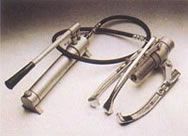
Product name: | YFL Hydraulic Puller | |||||
| specification: |   Zoom in on the image Zoom in on the image |
||||||
| Category: | Hardware tools -- hydraulic puller | ||||||
| |
Price: | factory price | |||||
| Brand: | Shanghai | ||||||
| Place of Origin: | China | ||||||
| |
Available Quantity: | batch | |||||
| delivery cycle: | Spot goods (or inquire by telephone) | ||||||
 |
|
||||||
1、 Working principle
YFL hydraulic puller is a replacement product of DYF, which adopts high-strength alloy steel claws and advanced production technology, and has the characteristics of long service life. The hydraulic starting rod moves forward directly, so the pushing rod itself does not rotate. The hook and claw seat can also be adjusted to move forward and backward directly with the thread. During operation, as long as the handle swings back and forth slightly, the hydraulic starting rod moves forward, and the hook and claw correspondingly moves backward to pull out the pulled object. If space permits, our company's wheel puller (YZL integrated hydraulic puller) can be used.
1. The YDL50-500T electric hydraulic puller has a larger tonnage.
2. The SCN50-500T small car lifting electric puller has the characteristic of easy movement.
3. YZL5-50T integrated wheel puller (hydraulic puller) is suitable for large spaces.
4. The YLM5-100T mobile puller has the characteristic of being movable.
5. The EPHR/EP3-100T series anti slip wheel puller has anti slip devices for higher safety.
2、 Application scope
Hydraulic puller is an idealized new tool that replaces traditional puller. Easy to operate, effortless to use, not limited by location, compact structure, flexible use, light weight, small size, easy to carry, suitable for factories and repair sites.
3、 Performance parameters
| Model | YFL-5 | YFL-10 | YFL-20 | YFL-30 | YFL-50 | YFL-100 |
| Safe Load Capacity T | five | ten | twenty | thirty | fifty | one hundred |
| Travel distance mm | one hundred | one hundred and twenty-five | one hundred and twenty | one hundred and fifty | one hundred | one hundred and sixty |
| Three claw adjustment range mm | 50-250 | 50-300 | 100-450 | 200-500 | 250-600 | 250-600 |
| Rated pressure of pump (MPa) | forty | sixty-three | sixty-three | sixty-three | sixty-three | sixty-three |
| old model | DYF-5 | DYF-10 | DYF-20 | DYF-30 | DYF-50 | DYF-100 |
 Related Products: Related articles:
 Universal Accessories Rubber hardware Cutting tools Measuring scales Welding equipment power tool pneumatic tool hydraulic tool
  hydraulic cylinder refueling truck hydraulic press oil purifier Hydraulic components hydraulic wrench hydraulic puller
  bearing heater Hydraulic hole punch Hydraulic crimping pliers hydraulic jack Hydraulic stretching tool Hydraulic bending tool Hydraulic cutting tool Bender|Threading machine manual tools Lifting tools power tools diamond tools abrasives and abrasive tools Mold casting Cleaning and lubrication Architectural Hardware Machinery and equipment
 Home|Quality Commitment|Ordering|Payment method|product delivery|support|Disclaimer|Contact Us
Copyright®2011 www.91way.com Copyright.
Phone:+86-21-66770508 +86-13916500500 Fax:+86-21-66108310
Email:91way@163.com Wechat:40606422
沪ICP备2021005791号  沪公网安备31010702003255号
 Your location:

