Application of JSJ-4 AC power-off delay relay:
The JSJ series static AC power-off relay is used in relay protection and automation circuits for AC operation, as a time element for delayed return after AC instantaneous action power-off.
Working Principle:
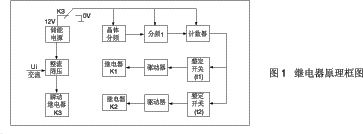
The principle block diagram of the relay is shown in Figure 1. As shown in the figure, the relay consists of a crystal oscillator, a frequency divider, a setting switch, a driving circuit, and a power supply circuit. When the rated point voltage is applied to the relay, the internal instantaneous relay and two delay relays of the relay act instantaneously, the contacts switch, and the power circuit and timing circuit are in a power-off state to improve the anti-interference performance of the relay. When the input voltage drops significantly or completely disappears, the instantaneous relay returns instantly (the two delay execution relays are still in action), and the contacts also return instantly, connecting the energy storage power supply to the timing circuit. The crystal oscillates to generate a clock pulse, which is divided into 10ms. The counter counts the timing pulse, and when the counted pulse number matches the set switch value, it drives the execution relay to return, completing the function of delayed return after power failure.
Usage:
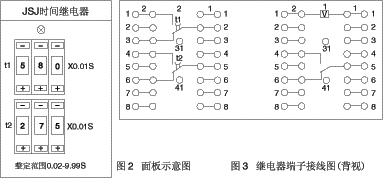
The relay panel diagram is shown in Figure 2. The upper three digit switch in the diagram sets the delay return time t1 of relay K1, and the lower three digit switch sets the delay return time t2 of relay K2. Multiplying the three digit switch by 0.01S is the time setting value. For example, if the three digit setting is 580, the time setting value is 580 × 0.01S=5.8S. The setting values of t1 and t2 can be equal or not equal.
Main technical parameters:
5.1 Rated voltage: AC 380V, 220V, 110V, 100V.
5.2 Rated frequency: 50HZ or 60HZ.
5.3 Ensure that the voltage required for reliable energizing of relay contacts is not greater than 70% of the rated voltage.
5.4 Ensure that the reliable power-off return voltage of the relay is not less than 10% of the rated voltage.
The delay error of relay power-off delay return under rated voltage shall not exceed 0.1% of the setting value+10ms within the setting range.
5.6 Under rated voltage, the variation of relay power-off delay shall not exceed 0.1% of the rated value+10ms. Variation refers to the difference between the maximum and minimum values of the relay measured five times at the same time setting point.
5.7 The two delayed return contacts can be independently set, with a time setting range of 0.02s-9.99s, and the delay setting values can be different or the same.
The power consumed by the relay at rated voltage shall not exceed 4VA.
5.9 Relays are allowed to withstand 110% of rated voltage for a long time.
5.10 The relay has a contact breaking capacity of 30W in a DC inductive circuit with a voltage not exceeding 250V and a current not exceeding 1A (time constant T=5ms ± 0.75ms), and a contact breaking capacity of 150VA in an AC circuit with a voltage not exceeding 250V, a current not exceeding 1A, and a power factor COSO=0.4 ± 0.1.
5.11 The effective voltage between each circuit of the relay and the exposed non charged metal parts should be able to withstand 2kV, and the input circuit and contacts should be able to withstand 1kV, 50HZ AC voltage. After a 1-minute experiment, there should be no insulation breakdown or flashover phenomenon.
5.12 The relay can operate reliably within the temperature range of -10 ° C to 40 ° C.
5.13 Relay has a mechanical lifespan of 105 times and an electrical lifespan of 104 times.
5.14 Relay weight: approximately 0.5kg.
Wiring diagram behind the relay:
The wiring terminal diagram of the relay is shown in Figure 3. The contacts in the diagram are the state after the relay loses power. When the rated AC voltage is applied, the instantaneous contact K3, the contact K1 with a delay time of t1, and the contact K2 with a delay time of t2 all act simultaneously. At this time, the contact state is opposite to that shown in Figure 3. When the applied voltage suddenly loses power (voltage), the instantaneous contact K3 immediately returns, and the delayed contact K1 returns after a delay of t1 after power failure. Similarly, the delayed contact K2 returns after a delay of t2 after power failure. The contact state after return is shown in Figure 3.
Relay external dimensions and opening dimensions:
Refer to Figures 2 and 6 in the protruding modular insertion structure.
Ordering instructions:
7.1 Relay model and name;
7.2 Rated voltage;
7.3 Order quantity.

 Your location:Home → low-voltage electrical apparatus → relay → time relay → JSJ-4 AC power-off delay relay

 No image available


 Related Products:
 SHZ1(ST8) Intelligent Dual Digital Time Relay..
 low-voltage circuit breaker
  thermal relay
 沪公网安备31010702003255号
