
 Your location:Home → low-voltage electrical apparatus → relay → Impact relay → JC-13,14 type impulse relay
 |
Product name: | JC-13,14 type impulse relay | |||||
| specification: |   No image available No image available |
||||||
| Category: | low-voltage electrical apparatus -- Impact relay | ||||||
| |
Price: | factory price | |||||
| Brand: | |||||||
| Place of Origin: | China | ||||||
| |
Available Quantity: | batch | |||||
| delivery cycle: | Spot goods (or inquire by telephone) | ||||||
 |
|
||||||
Purpose:
JC-13、 The 14 type impact relay (hereinafter referred to as the relay) is mainly used for alarm starting sound in various faults of relay protection and safety automatic device circuits. It is a repetitive action component of the central sound alarm circuit in power stations, substations, and related projects.
Relay model name: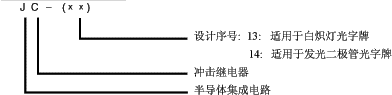
Working Principle:
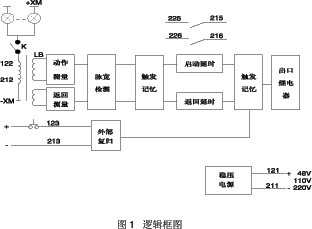
JC-13、 The 14 type relay consists of a transformer, measurement sampling pulse width detection, trigger memory, automatic reset, delayed action and delayed return, and voltage stabilization circuit. The logic diagram is shown in Figure 1.
When a certain circuit light sign lights up, current flows through the primary winding of the inverter of the relay, inducing a pulse voltage on the secondary winding of the inverter. This voltage is sent to the action measurement and return measurement circuits respectively. Since the action measurement only judges the output when the light is on, there is no output when the light is off, and the return measurement only judges the output when the light is off and there is no output when the light is on, the action measurement and return measurement will not have outputs at the same time. The measurement output is sent to the pulse width detector to avoid relay misoperation caused by induced voltage in the circuit. After determining the pulse width, it is sent to the trigger memory circuit, and the output of the trigger memory circuit is sent to the action delay and return delay circuits. After meeting the set time, it is output to the outlet relay.
Due to the memory function of the triggering circuit, when the light sign lights up for the first time, the relay will act. If the light sign lights up again, the circuit will no longer detect pulses until one of the light signs goes out. After the predetermined return time, the relay will return or be reset externally. The relay enters the loop state again.
The relay has a delay circuit for both action and return, aiming to ensure the interoperability of accident and warning signals in the starting audio system. At the same time, the relay is also equipped with an external reset interface. This relay can replace any current impact relay and save users the time relay used in the original equipment.
Main technical parameters:
4.1 DC rated voltage: 48V, 110V, 220V ± 20%, DC ripple<7%
4.2 Minimum impulse action current: JC-13 0.1A; JC-14 0.01A.
4.3 Maximum thermal stability current: JC-13 4A; JC-14 0.8A.
4.4 Minimum impulse return current: JC-13 0.1A; JC-14 0.01A
4.5 Rated number of impact circuits: JC-13 ≤ 40 circuits; JC-14 ≤ 80 routes.
4.6 Contact Capacity: In a DC circuit with a voltage not exceeding 250V, a current not exceeding 1A, and a time constant of 40ms, the contact breaking capacity is 30W. In an AC circuit, it is 500VA (coso=0.4 ± 0.1). The long-term current passing through the contact is 5A.
4.7 Power consumption
4.7.1 Under DC rated voltage, it is ≤ 3W.
4.7.2 Measure circuit power consumption ≤ 2W at maximum thermal stability current
4.8 Delay adjustment range action: 0-9s, return: 0-9s.
Level difference: 1s Error: 10%.
4.9 The relay can withstand a voltage withstand test of 2kV, 50Hz, and 1min between different circuits. Each contact can withstand a 1kV, 50Hz, 1-minute withstand voltage test without breakdown or flashover.
4.10 The anti-interference test and insulation test of the relay comply with the ZBK-45020 standard.
4.11 The relay adopts Combiflex structure, with external dimensions shown in Figure 2 (2S12C) and installation dimensions according to Figure 6 (2S12C).
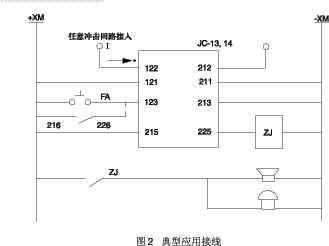
Wiring diagram behind the relay:
Application extension:
Due to the delay action and delay return time circuit in JC-13 and 14 relays, with delay action setting t1 and delay return setting t2, there are multiple applications that can be extended.
6.1 Signal triggered automatic reset
No reset button: After signal start t1, the relay starts, and after signal reset t2, the relay returns.
6.2 Manual Reset
After the signal starts t1, the relay starts, and after the hand returns, the relay returns.
6.3 Relay self resetting
The relay contacts are connected in series to the reset circuit. After the signal is activated t1, the relay starts, and after the relay acts t2, it returns.
Relay external dimensions and opening dimensions:
Refer to Figures 2 and 6 in the protruding modular insertion structure.
Ordering instructions:
Orders should specify the model, name, specifications, and quantity of the product.
 Related Products: Related articles:
 low-voltage circuit breaker low-voltage contactor Low voltage transformer relay
  thermal relay Temperature relay time relay Universal relay intermediate relay power relay current relay overcurrent relay voltage relay signal relay Flash relay Differential relay Impact relay
  Position relay Frequency relay Phase relay Locking relay pressure relay gas relay Coaxial relay Polarized relay automotive relay Leakage relay Phase failure relay solid state relay electromagnetic relay Explosion proof relay Module relay Other relays Relay socket Reclosing relay Acceleration relay Power direction relay Synchronous grounding relay Insulation monitoring relay Counter | timer Low-voltage fuse starter electromagnet resistor Low-voltage arrester power capacitor Low voltage reactor dual power switch Low voltage isolator changeover switch Master Electrical Appliance terminal block plug socket electromagnetic chuck Electrotechnical equipment lighting distribution box Low voltage protector Electric cabinet door lock handle Building electrical appliances
 Home|Quality Commitment|Ordering|Payment method|product delivery|support|Disclaimer|Contact Us
Copyright®2011 www.91way.com Copyright.
Phone:+86-21-66770508 +86-13916500500 Fax:+86-21-66108310
Email:91way@163.com Wechat:40606422
沪ICP备2021005791号  沪公网安备31010702003255号


