ZC-23/23A impact relay is a type of impact relay composed of components such as capacitors, diodes, filters, and reed relays. Relays can be used as centralized signals in relay protection and automatic control systems operated by DC and three-phase full wave rectification power supplies.
Working Principle:
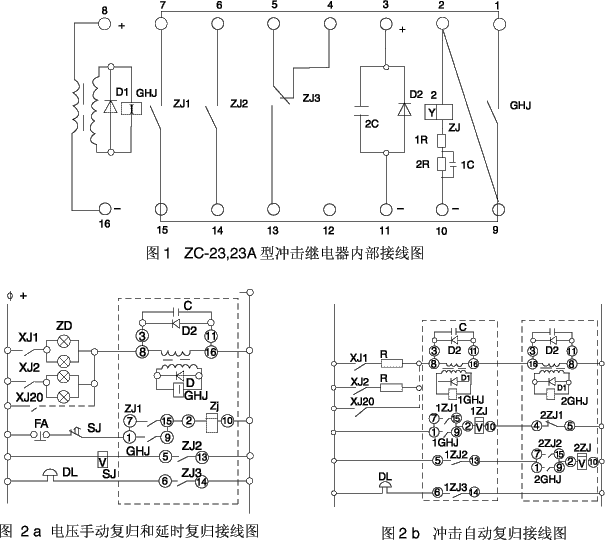
2.1 Action principle: The internal wiring is shown in Figure 1.
Using a differential inverter connected in series in a DC signal circuit, the continuous (rectangular) current pulse or short (pointed) current pulse in the circuit is converted to activate the sensitive element, and then the sensitive element is used to activate the intermediate element of the outlet. The specific working process is as follows:
2.1.1 Relay action
Short circuit terminals 3 and 8 to the positive power supply, short circuit terminals 11 and 16 to the negative power supply, as shown in Figure 2A. When the signal circuit gives an impulse signal (current), it is differentiated by the converter LB and sent to the coil of the sensitive element GHJ to activate the intermediate relay ZJ at the outlet. Then, the ZJ contact starts the bell or whistle to emit an audio signal. When the sharp pulse on the GHJ coil passes, the GHJ contact returns empty load, and ZJ maintains itself by its contact ZJI.
2.1.2 Return process
Press the button FA (or the dynamic breaking contact of the time relay) and it will automatically disconnect after a certain period of time. )The ZJ coil loses power, all its contacts return, and the audio signal stops. At this point, although the signal circuit current has not disappeared, it has reached a stable di/dt=0, and there is no voltage on the GHJ coil, so it cannot operate (nor maintain). Therefore, all components of the relay have been reset and are ready for a second operation. When the signal (current) in the signal circuit disappears, a reverse pulse is generated on the coil of the sensitive element GHJ due to the action of the differential inverter. This voltage pulse is bypassed by the diode DI, so GHJ does not operate and the entire relay cannot operate.
2.1.3 If an impact automatic reset circuit is required, two impact relays can be connected in reverse series (refer to Figure 2b for specific usage) to achieve it. However, in the case where the signal circuit must be a linear resistor, impact automatic reset can be achieved.
Main technical parameters:
3.1 Rated voltage (VDC): 220110.
3.2 The minimum impulse action current of ZC-23 type impulse relay shall not exceed 0.16A.
3.3 The minimum impulse action current of ZC-23A type impulse relay shall not exceed 0.015A.
3.4 Maximum stable current: ZC-23 is 3.2A, ZC-23A is 0.8A.
3.5 Export intermediate component ZJ: When the ambient temperature is+20 ℃ and the coil is in a cold state, it should reliably operate at 80% of the rated voltage and reliably return at not less than 5% of the rated voltage.
3.6 At extreme temperatures (+50 ℃, -20 ℃), the impulse current of the relay shall not exceed 0.2A.
3.7 Disconnecting capacity: The voltage does not exceed 220V, the current does not exceed 0.2A, and the (ZJ contact of the outlet intermediate component) disconnecting capacity is 40W in a DC inductive load (T=5 × 10⁻³s) circuit, and 50VA in an AC circuit with voltage not exceeding 220V and current not exceeding 0.3A.
3.8 Power consumption
3.8.1 When the primary winding of the converter LB passes a current of 3.2A, its power consumption shall not exceed 7W.
3.8.2 The power consumption of the export intermediate component ZJ shall not exceed 10W at rated voltage.
Relay external dimensions and opening dimensions:
ZC-23 and 23A impact relays have a protruding plug-in structure.
The appearance and installation dimensions of ZC-23 and 23A impact relays are shown in Figure 4 of the universal structural system.
Ordering instructions:
Please indicate the product model, name, and quantity.

 Your location:Home → low-voltage electrical apparatus → relay → Impact relay → ZC-23/23A type impulse relay

 Zoom in on the image
 Related Products:
 low-voltage circuit breaker
  thermal relay
 沪公网安备31010702003255号

