
 Your location:Home → low-voltage electrical apparatus → relay → intermediate relay → JQ-2 type electromagnetic relay
 |
Product name: | JQ-2 type electromagnetic relay | |||||
| specification: |   No image available No image available |
||||||
| Category: | low-voltage electrical apparatus -- intermediate relay | ||||||
| |
Price: | factory price | |||||
| Brand: | |||||||
| Place of Origin: | China | ||||||
| |
Available Quantity: | batch | |||||
| delivery cycle: | Spot goods (or inquire by telephone) | ||||||
 |
|
||||||
2. Action principles and structural characteristics
2.1 Action principle:
When a direct current is applied to the coil of the relay, current flows through the coil, causing the iron core to be magnetized and the dynamic spring on the armature to rotate with the rotation of the armature, ultimately causing the contact to close. When the coil is powered off, the magnetic force disappears and the armature returns to its original position due to the reaction pressure of the spring plate.
2.2 Structural Features
This relay is an electromagnetic relay, and the power supply to the coil is direct current. Its components are the iron core, yoke plate, armature, coil, and contact system. The top of the yoke plate has an angular blade, but the armature rotates flexibly on the blade. The center of the armature is equipped with an adjustable magnetic isolation pin, which can adjust the suction and release time when necessary.
Technical data of JQ-2 electromagnetic relay
3.1 The relay has a pair of bridge type dynamic closing main contacts and a pair of bridge type auxiliary contacts for protecting the main contacts.
3.2 The pull in current and coil resistance of the relay are shown in Table 1 below:
|
Preface number |
relay designation |
Equivalent to the old code name |
resistance (Ω) |
Pull in current (mA) |
Working Voltage (V) |
rated current (mA) |
|
one two three four five six |
4JS.501.200 4JS.501.201 4JS.501.202 4JS.501.203 4JS.501.204 4JS.501.205 |
nine thousand one hundred and eighty-seven nine thousand one hundred and eighty-nine nine thousand one hundred and eighty-eight nine thousand six hundred and forty-six three thousand and two nine thousand five hundred and twenty-seven |
two hundred four thousand eight hundred four thousand and five hundred one thousand six hundred and twenty three hundred and forty |
≤85 ≤22 ≤45 ≤12 ≤30 ≤50 |
≤24 ≤100 ≤48 ≤60 ≤60 ≤24 |
≤130 ≤28 ≤65 ≤13 ≤50 ≤70 |
When the ambient air temperature is+20 ℃, the power supplied to the coil shall not exceed 5W, and the relay shall be able to operate for a long time at this rated power with a temperature rise not exceeding 60K.
3.4 Insulation resistance of relay: between coil, contact spring and magnetic conductor:
3.4.1 Under the condition of a temperature of 20K5 ℃ and a relative temperature of 65K15%, the voltage should not be less than 500MV.
3.4.2 Maintain a voltage of 48 not less than 10MV under the condition of a relative temperature of 95% K3% at a temperature of 20K5 ℃.
3.5 Dielectric strength of relay:
3.5.1 The contact spring and the magnetic conductor are subjected to AC 50Hz, voltage 1.5KV, and withstand for 1 minute.
3.5.2 The coil and magnetic conductor are subjected to AC 50Hz, voltage 500V, and withstand for 1 minute
3.6 Disconnecting ability of contacts
3.6.1 In a DC circuit, when the voltage is not greater than 110V, the maximum breaking power of the contacts is 1000W (no inductance).
When the voltage in the AC circuit is not greater than 220V, the maximum breaking power of the contacts is 2000VA.
3.6.3 The relay can be closed 105 times under the conditions specified in paragraphs 3.6.1 and 3.6.2.
3.6.4 The current through the contact shall not exceed 20A.
The weight of the 3.7 relay shall not exceed 0.320Kg.
3.8 The appearance and installation dimensions of the relay are shown in Figure 1.
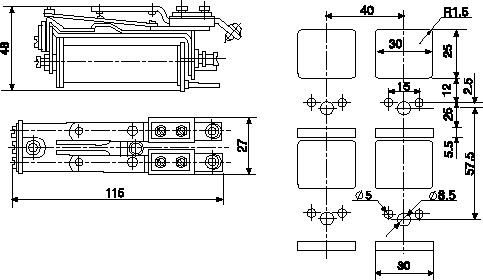
Figure 1: Outline and Installation Dimensions of JQ-2 Relay
4 Ordering Instructions
4.1 Model and name of relay.
4.2 Relay code.
 Related Products:
 JRW-230MA type electromagnetic relay JRW-230M.. JRW-230MF type electromagnetic relay JPW-220M type electromagnetic relay JMW-271M type electromagnetic relay JMW-270M type electromagnetic relay KJRW-16MA type electromagnetic relay JRW-240MD type electromagnetic relay JRW-240M.. JRW-240M type electromagnetic relay JRW-240M,.. JRW-230M type electromagnetic relay JRW-230M,.. JRW-220M type electromagnetic relay JRW-220M,.. Related articles:
 low-voltage circuit breaker low-voltage contactor Low voltage transformer relay
  thermal relay Temperature relay time relay Universal relay intermediate relay
  power relay current relay overcurrent relay voltage relay signal relay Flash relay Differential relay Impact relay Position relay Frequency relay Phase relay Locking relay pressure relay gas relay Coaxial relay Polarized relay automotive relay Leakage relay Phase failure relay solid state relay electromagnetic relay Explosion proof relay Module relay Other relays Relay socket Reclosing relay Acceleration relay Power direction relay Synchronous grounding relay Insulation monitoring relay Counter | timer Low-voltage fuse starter electromagnet resistor Low-voltage arrester power capacitor Low voltage reactor dual power switch Low voltage isolator changeover switch Master Electrical Appliance terminal block plug socket electromagnetic chuck Electrotechnical equipment lighting distribution box Low voltage protector Electric cabinet door lock handle Building electrical appliances
 Home|Quality Commitment|Ordering|Payment method|product delivery|support|Disclaimer|Contact Us
Copyright®2011 www.91way.com Copyright.
Phone:+86-21-66770508 +86-13916500500 Fax:+86-21-66108310
Email:91way@163.com Wechat:40606422
沪ICP备2021005791号  沪公网安备31010702003255号

