1. Scope of application
The BBM60 series molded case circuit breaker (hereinafter referred to as the circuit breaker) is one of the new circuit breakers developed and researched by our company using international advanced design and manufacturing technology. Its rated insulation voltage is 800V, suitable for infrequent switching and motor starting in circuits with AC 50Hz (60Hz), rated working voltage of 690V and below (DC 250V and below), and rated working current up to 1250A. Circuit breakers have overload, short circuit, and undervoltage protection devices that can protect the circuit and power equipment from damage.
Circuit breakers are classified into four types based on their rated ultimate short-circuit breaking capacity (Icu): C-type (basic type), L-type (standard type), M-type (higher breaking type), and H-type (high breaking type). This circuit breaker has the characteristics of small size, high breaking height, short arcing (some specifications have zero arcing), and anti vibration, making it an ideal product for land and ship use.
This circuit breaker can be installed vertically or horizontally.
This circuit breaker product complies with the following standards:
IEC 947-1 and GB14048.1 General Principles
IEC 947-2 and GB14048.2 Low Voltage Circuit Breakers
IEC 947-4 and GB14048.4 Contactors and Motor Starters
IEC 947-5.1 and GB14048.5 Electromechanical Control Circuit Electrical Appliances
2. Main technical parameters
Altitude below 2000m.
The temperature of the surrounding medium shall not exceed+40 ℃ (+45 ℃ for marine products) and shall not be lower than -5 ℃.
Can withstand the influence of humid air.
Can withstand the effects of salt spray and oil spray.
Can tolerate the influence of mold.
Capable of withstanding the effects of nuclear radiation.
The maximum inclination is 22.5 °.
Can work reliably under normal ship vibration.
Can work reliably under earthquake conditions (4g).
In a medium without explosive hazards, and where there are no gases or conductive dust that can corrode metals or damage insulation.
In a place without rain or snow invasion.
3. Model and meaning
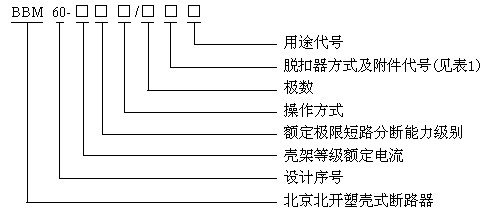
Note:
Circuit breakers for power distribution have no code; The circuit breaker for protecting the motor is represented by 2.
The handle can be operated directly without a code; Electric operation function P represents; Rotate the handle and use Z to indicate.
According to the number of poles in the product, it can be divided into two poles (100, 225 types), three poles, and four poles (BBM-1250 without four poles). Neutral pole (N pole) in quadrupole products
There are four types:
Type A: The N pole does not have an overcurrent release component installed, and the N pole is always connected and does not open or close together with other three poles;
Type B: The N-pole is not equipped with overcurrent release components, and the N-pole is connected and disconnected together with the other three stages; (N-pole first closes and then splits);
Type C: The N-pole is equipped with an overcurrent release element, and the N-pole is connected and disconnected together with the other three stages; (N-pole first closes and then splits);
D-type: The N-pole is equipped with an overcurrent disconnect component, and the N-pole is always connected without being connected or disconnected together with other three poles.
Divided by rated current (A):
BBM60-63 is rated as Level 9 (6), 10, 16, 20, 25, 32, 40, 50, 63A (6A specification without overload protection);
BBM60-100 is classified as level 10, 16, 20, 25, 32, 40, 50, 63, 80, 100A;
BBM60-160 is classified into four levels: 100, 125, 140, and 160;
BBM60-225 is classified into seven levels: 100, 125, 140, 160, 180, 200, and 225A;
BBM60-400 is classified into five levels: 225, 250, 315, 350, and 400A;
BBM60-630 is classified into three levels: 400, 500, and 630A;
BBM60-800 is classified into three levels: 630, 700, and 800; [() is not recommended specification]
BBM60-1250 is classified into three levels: 800, 1000, and 1250A.
According to the wiring method, it can be divided into three types: front board wiring, back board wiring, and plug-in wiring.
There are two types of overcurrent release devices: thermal electromagnetic (compound) type and electromagnetic (instantaneous) type.
There are two types of accessory devices: those with accessory devices and those without accessory devices. Accessory devices are divided into internal devices and external devices
There are four types of internal devices: shunt release, undervoltage release, auxiliary contact, and alarm contact;
External devices include rotating handle operating mechanisms, electric operating mechanisms, interlocking mechanisms, and wiring terminals for auxiliary devices.

 Your location:Home → low-voltage electrical apparatus → low-voltage circuit breaker → Molded Case Circuit Breaker → BBM60 series molded case circuit breaker

 Zoom in on the image

 Related Products:
 DZ931 Marine molded case circuit breaker
 low-voltage circuit breaker
  Molded Case Circuit Breaker
 沪公网安备31010702003255号
