
 Your location:Home → mechanical transmission → Brake | Clutch → electromagnetic brake → AZML series power-off braking type three-phase AC electromagnetic brake
 |
Product name: | AZML series power-off braking type three-phase AC electromagnetic brake | |||||
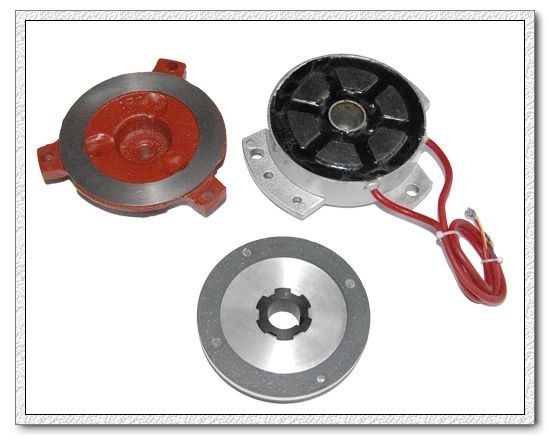
| specification: |   Zoom in on the image Zoom in on the image |
||||||
| Category: | mechanical transmission -- electromagnetic brake | ||||||
| |
Price: | factory price | |||||
| Brand: | Shanghai | ||||||
| Place of Origin: | China | ||||||
| |
Available Quantity: | batch | |||||
| delivery cycle: | Spot goods (or inquire by telephone) | ||||||
 |
|
||||||
The AZML series power-off braking three-phase AC electromagnetic brake is a new type of safety brake with the characteristics of fast starting time and short braking time. The brake coil is completely sealed in epoxy resin, making it safe and reliable to use. Its protection level is IP54 and insulation level is F.
The AZML series three-phase AC brake can directly use a variable frequency power supply in the frequency range of 25-50Hz. To be used in the frequency range of 5-100Hz, the brake needs to be powered directly from a 50Hz standard power supply.
The AZML series three-phase AC brake can be paired with Y and Y2 series motors to form the YEJA AC brake three-phase asynchronous motor.
Structure and working principle:
When the brake coil (11) is connected to the three-phase AC power supply, the magnetic yoke assembly (15) generates a magnetic field, attracts the armature assembly (8), compresses the brake spring (9), and separates the brake disc (7) from the armature assembly (8) and the brake mounting seat (5), and the motor can operate normally. When the brake coil (11) is powered off, the magnetic field of the yoke assembly (15) quickly disappears, and the brake spring (9) pushes out the armature assembly (8), compressing the brake disc (7). The brake disc is subjected to the frictional torque of the armature assembly and the brake mounting seat, quickly stopping the motor shaft and stopping the motor from rotating. The second power on will repeat the above work.
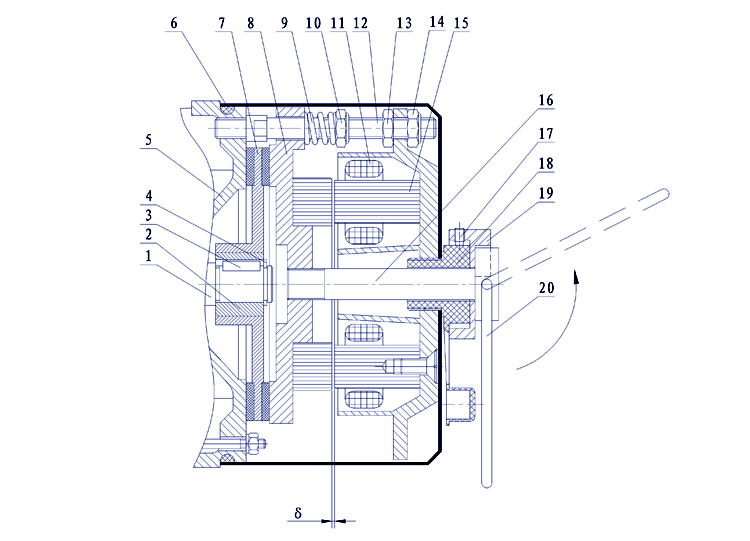
1. Rotor 2, Spline 3, Flat key 4, Elastic retaining ring for shaft 5, Brake mounting seat 6, Sealing ring 7, Brake disc 8, Armature assembly 9, Brake spring 10, Lock nut 11, Coil 12, Double headed bolt 13, Nut 14, Nut 15, Magnetic yoke assembly 16, Release bolt 17, Hexagonal countersunk screw 18, Guard screw 19, Release disc 20, Release ring δ, Gap
Adjustment and release of braking torque:
Adjustment method: Rotate the locking nut (10) clockwise to compress the brake spring (9), increasing the torque. If not, the torque will decrease. When adjusting, the three adjustment nuts should evenly compress the brake spring, otherwise the torque will be unbalanced.
Release method: The release of brake torque can be achieved through the release ring (20). Pull the release ring upwards, use the lever principle, and use the release disk (19) as the fulcrum to drive the release bolt (16), thereby driving the armature component (8) to push towards the magnetic yoke component, causing the friction plate to detach from the armature component, achieving the release of brake torque. This is only used when installing, debugging, or repairing equipment, and must be restored to the braking state during normal operation, otherwise it will not work properly.
Inspection and adjustment of gaps:
The distance between the magnetic yoke component and the armature component is called the gap (δ), and the normal working gap is 0.2-0.35mm. The brake can only work normally within this gap range. When the gap is greater than 0.5mm, the brake will emit a screaming electromagnetic sound and must be stopped immediately until the gap is readjusted to the normal range. Adjust the gap using nuts (13) and (14).
Adjustment method: Find a plug with a thickness of 0.25 from the feeler gauge and insert it into the δ near the double headed bolt (12) to be adjusted. Loosen the nut (13) about half a turn, tighten the nut (14), slightly press the plug, remove the plug, and then tighten the nut (13). Use a feeler gauge to measure whether the gap is between 0.25-0.35mm. Adjust the other two points using the same method, and keep the difference in uniformity between the three points at around 10%. If the difference is too large, make some minor adjustments. (Note: Anti loosening paste must be added to nut (13) to prevent loosening.)
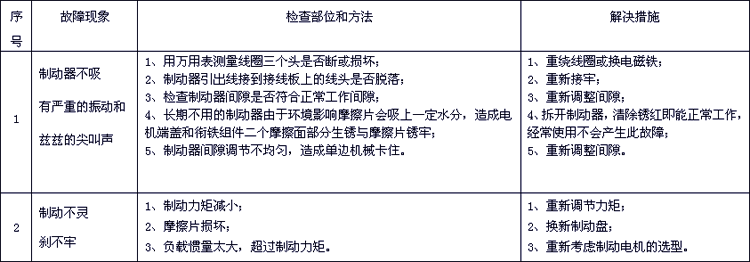
Brake maintenance:
 Related Products:
 TQWZ3 series electric forklift electromagneti.. DZD5-1000 type electromagnetic brake DZD5-320 type electromagnetic brake DZD5-160 type electromagnetic brake DZD5-80 type electromagnetic brake DZD5-40 type electromagnetic brake DZD5-20 type electromagnetic brake DZD5-10 type electromagnetic brake DZD5-5 type electromagnetic brake YHDE Electromagnetic brake multi speed three-.. Related articles:
 speed reducer
  conveyor elevator gearbox divider backstop Brake | Clutch Brake rectifier electromagnetic brake
  Magnetic particle brake eddy current brake Hydraulic thruster Hydraulic brake system electromagnetic clutch Magnetic Particle Clutch Combination clutch Centrifugal clutch overrunning clutch Cam clutch one-way clutch hydraulic clutch Pneumatic brake pneumatic clutch hydraulic coupling buffer shock absorber drive belt drive wheel drive shaft coupling expansion sleeve Chain wheel chain motor bearing motorized roller industrial remote control
 Home|Quality Commitment|Ordering|Payment method|product delivery|support|Disclaimer|Contact Us
Copyright®2011 www.91way.com Copyright.
Phone:+86-21-66770508 +86-13916500500 Fax:+86-21-66108310
Email:91way@163.com Wechat:40606422
沪ICP备2021005791号  沪公网安备31010702003255号

