
 Your location:Home → low-voltage electrical apparatus → relay → overcurrent relay → JFL-14 type negative sequence overcurrent relay
 |
Product name: | JFL-14 type negative sequence overcurrent relay | |||||
| specification: |   No image available No image available |
||||||
| Category: | low-voltage electrical apparatus -- overcurrent relay | ||||||
| |
Price: | factory price | |||||
| Brand: | |||||||
| Place of Origin: | China | ||||||
| |
Available Quantity: | batch | |||||
| delivery cycle: | Spot goods (or inquire by telephone) | ||||||
 |
|
||||||
Application of JFL-14 Negative Sequence Overcurrent Relay:
The JFL-14 negative sequence overcurrent relay is used as a backup protection for asymmetric short circuits and negative sequence overload protection.
This relay consists of an integrated circuit that forms a filtering circuit and an execution circuit, with advantages such as high sensitivity, fast speed, and low power consumption. The setting of the relay is carried out using a dial switch on the panel, which is intuitive and convenient. The relay is equipped with two negative sequence current settings, and the small action value range can lock the large action value range, forming a dual configuration.
Working Principle:
The current measurement circuit consists of a current transformer and a negative sequence current filter, while the phase shifter and adder form the negative sequence current filter. UCK2 is delayed by a phase shifter by 90 and amplified by 2/3 times before being added to UCK1 to form the negative sequence current filter output UCK5.
UCK5=UCK1+(- J) * 2/SQRT (3) * UCK2;
For LH1, choose W34=2W56, which means WA=3WO;
For LH1, choose W34=W56, i.e. WB=WC;
When the zero sequence component is input, IAO=IBO=ICO=IO, while in WO, IAOWA-3IOWO=O is calculated based on the ampere turn principle using 3IO; IBOWB-ICOWC=O, So the secondary side of current converters LH1 and LH2 does not reflect zero sequence components.
Properly selecting parameters to ensure that when inputting three-phase positive sequence current, UCK5 = O。
Therefore, when inputting three-phase negative sequence current, UCK5 = 2UCK1 = 4 3UCK2。
The output UCK5 of the negative sequence current filter is compared with the threshold voltage of the level detection after being set to a fixed value, rectified, and filtered.
During normal operation and symmetrical three-phase short circuit, UCK5 = 0V, The level detection outputs a positive signal, but the relay does not operate.
When a two-phase short circuit occurs, the fault current reaches UCK6>UCP2, UA47 is a negative signal, and J1 acts; UCK7>UCP4, UA67 is a negative signal, J2 is activated.
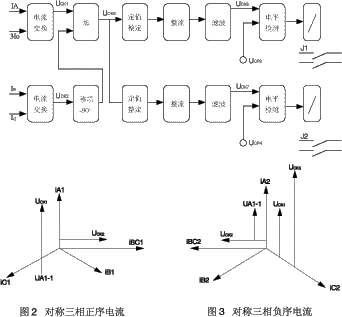
Main technical parameters of JFL-14 negative sequence overcurrent relay:
5.1 AC rated current: 5A, 1A, 50Hz.
5.2 DC rated voltage: 110V, 220V.
5.3 Power consumption: AC current circuit: ≤ 1VA/phase at rated current of 5A;
Under rated current of 1A, ≤ 0.5VA/phase.
DC voltage circuit ≤ 3W (110V);
≤5W(220V)。
5.4 Setting range and level difference diagram
5.5 Scale error: ≤ 5%.
5.6 Return coefficient: ≥ 0.95.
5.7 The discrete value of various two-phase short-circuit action currents is ≤ 5%.
5.8 Action time: ≤ 25ms; tested at twice the action current.
5.9 Return time ≤ 30ms, tested from 10 times the action current to 0.8 times the return current.
The conductive circuits of the 5.10 dielectric strength relay should be able to withstand an AC test voltage of 2kV (effective value) and 50Hz between the exposed non charged metal parts and the casing, as well as between the input circuits and the contacts, for a duration of 1 minute without insulation breakdown or flashover.
5.11 Working conditions
a) The usage location does not allow explosive media, and the surrounding media should not contain corrosive metals, gases that damage insulation, or conductive media. It is not allowed to be filled with water vapor or have serious mold presence;
b) Strong vibrations and impacts are not allowed in the usage location;
c) The usage location should have facilities to defend against rain, snow, wind, and sand;
d) The usage location does not allow an external magnetic induction intensity exceeding 1.5mT.
5.12 Electrical anti-interference relays shall comply with GB7261 and GB6261 "Electrical anti-interference tests for static relays and protective devices".
Wiring diagram behind the relay:
The wiring diagram behind the relay is shown in Figure 4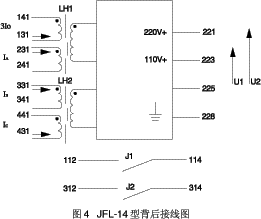
Relay external dimensions and opening dimensions:
Refer to Figures 4 and 8 in the protruding modular insertion structure.
Ordering instructions:
7.1 Product model, name, structural form, etc.
7.2 Order Quantity.
7.3 Relay matching: such as base, socket, etc. (must be ordered separately).
 Related Products:
 JGL-16 Time limited overcurrent relay JL-8DG Rail type timed overcurrent relay JL-8CG Rail type inverse time overcurrent rel.. HGL-10 series static inverse time overcurrent.. LL-7A series overcurrent relay DL-1A series overcurrent relay JL3 series overcurrent relay LL-5C type overcurrent relay SL-61,SL-62,SL-63,SL-64 series static overcur.. SL-11,SL-12 series static overcurrent relay Related articles:
 low-voltage circuit breaker low-voltage contactor Low voltage transformer relay
  thermal relay Temperature relay time relay Universal relay intermediate relay power relay current relay overcurrent relay
  voltage relay signal relay Flash relay Differential relay Impact relay Position relay Frequency relay Phase relay Locking relay pressure relay gas relay Coaxial relay Polarized relay automotive relay Leakage relay Phase failure relay solid state relay electromagnetic relay Explosion proof relay Module relay Other relays Relay socket Reclosing relay Acceleration relay Power direction relay Synchronous grounding relay Insulation monitoring relay Counter | timer Low-voltage fuse starter electromagnet resistor Low-voltage arrester power capacitor Low voltage reactor dual power switch Low voltage isolator changeover switch Master Electrical Appliance terminal block plug socket electromagnetic chuck Electrotechnical equipment lighting distribution box Low voltage protector Electric cabinet door lock handle Building electrical appliances
 Home|Quality Commitment|Ordering|Payment method|product delivery|support|Disclaimer|Contact Us
Copyright®2011 www.91way.com Copyright.
Phone:+86-21-66770508 +86-13916500500 Fax:+86-21-66108310
Email:91way@163.com Wechat:40606422
沪ICP备2021005791号  沪公网安备31010702003255号

