
 Your location:Home → motor products → motor driver → Stepper motor driver → SH2034D Stepper motor driver
 |
Product name: | SH2034D Stepper motor driver | |||||
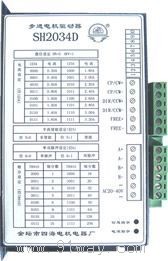
| specification: |   Zoom in on the image Zoom in on the image |
||||||
| Category: | motor products -- Stepper motor driver | ||||||
| |
Price: | factory price | |||||
| Brand: | |||||||
| Place of Origin: | China | ||||||
| |
Available Quantity: | batch | |||||
| delivery cycle: | Spot goods (or inquire by telephone) | ||||||
 |
|
||||||
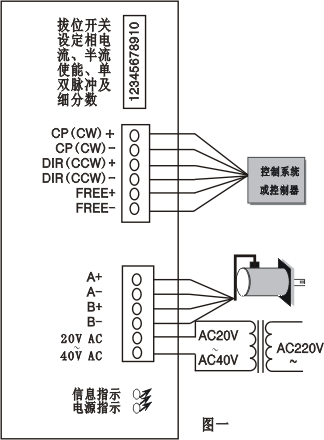
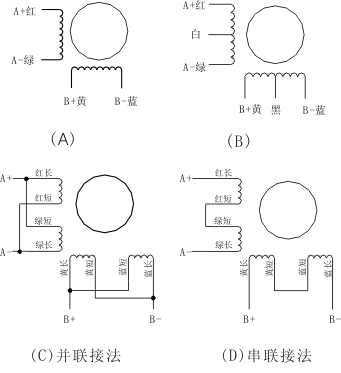
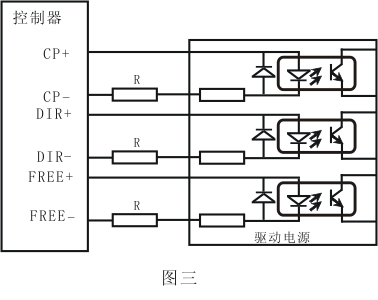
|
signal amplitude |
External current limiting resistor R |
|
5V |
not add |
|
12V |
680Ω |
|
24V |
1.8KΩ |
|
Phase current setting (bits 1, 2, 3, 4) | |||
|
1 2 3 4 |
phase current |
1 2 3 4 |
phase current |
|
0 0 0 0 |
0.2A |
1 0 0 0 |
1.8A |
|
0 0 0 1 |
0.4A |
1 0 0 1 |
2.0A |
|
0 0 1 0 |
0.6A |
1 0 1 0 |
2.2A |
|
0 0 1 1 |
0.8A |
1 0 1 1 |
2.4A |
|
0 1 0 0 |
1.0A |
1 1 0 0 |
2.6A |
|
0 1 0 1 |
1.2A |
1 1 0 1 |
2.8A |
|
0 1 1 0 |
1.4A |
1 1 1 0 |
3.0A |
|
0 1 1 1 |
1.6A |
1 1 1 1 |
3.2A |
|
Detail score setting (bits 7, 8, 9, 10) | |||
|
7 8 9 10 |
Detail score |
7 8 9 10 |
Detail score |
|
0 0 0 0 |
one |
1 0 0 0 |
eighteen |
|
0 0 0 1 |
two |
1 0 0 1 |
twenty |
|
0 0 1 0 |
four |
1 0 1 0 |
thirty-two |
|
0 0 1 1 |
five |
1 0 1 1 |
forty |
|
0 1 0 0 |
six |
1 1 0 0 |
fifty |
|
0 1 0 1 |
eight |
1 1 0 1 |
sixty-four |
|
0 1 1 0 |
ten |
1 1 1 0 |
one hundred and twenty-eight |
|
0 1 1 1 |
sixteen |
1 1 1 1 |
two hundred and fifty-six |
|
CP+: connected to the positive terminal of the pulse |
AC: Connected to 20-40V AC power |
|
CP -: Connected to the negative terminal of the pulse |
A+: Connected to motor A+wire package |
|
DIR+: Connect to the positive end of the direction |
A -: Connected to motor A - Wire package |
|
DIR -: Connect to the negative terminal of the direction |
B+: Connected to motor B+wire package |
|
FREE+: Connect to offline positive terminal |
B -: Connected to motor B - Wire package |
|
FREE -: Connect to offline negative terminal |
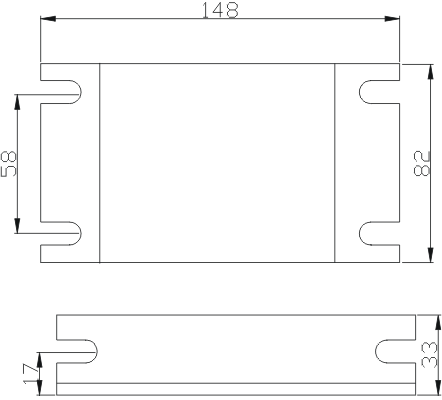
|
phenomenon |
reason |
solution |
|
The signal indicator light is flashing red |
1. The motor wire is short circuited |
1. Check the motor wires to eliminate short circuits |
| The signal indicator light flashes alternately in red and orange (Overvoltage) |
External voltage exceeds the driver |
1. Reduce external voltage |
|
The signal indicator light is red and constantly on |
The power supply voltage is too low | 1. Increase the voltage |
| The signal indicator light flashes alternately in red and green (Over temperature) |
The driver temperature exceeds the normal operating temperature | 1. Increase the heat dissipation area of the drive or replace the fan |
| The power indicator light is red and constantly on | Fuse damaged | Replace the fuse (same specification) |
 Related Products:
 J80PH-DK1,J80PH-DK3 type waveguide conversion.. J56PHX0,J56PHX01 type waveguide conversion dr.. 56PH0 type waveguide conversion driver 55PH01-F type waveguide conversion driver 55PH01,55PH02 type waveguide conversion drive.. 40PH1P2,J41PHX01 type waveguide conversion dr.. 40PHX90S,40PHR3S type waveguide conversion dr.. 40PHX90A,40PHX90B type waveguide conversion d.. 40PHX29,40PHX902 type waveguide conversion dr.. 40PHX90,40PHX901 type waveguide conversion dr.. Related articles:
 generator
  high-voltage motor synchronous motor DC motor asynchronous motor Special motor servo motor Transportation motor Speed motor single-phase motor stepper motor synchro torque motor coreless motor motor driver Motor starter cabinet Brushless motor controller Torque motor controller Stepper motor driver
  Servo motor driver Waveguide conversion driver motor speed controller encoder
 Home|Quality Commitment|Ordering|Payment method|product delivery|support|Disclaimer|Contact Us
Copyright®2011 www.91way.com Copyright.
Phone:+86-21-66770508 +86-13916500500 Fax:+86-21-66108310
Email:91way@163.com Wechat:40606422
沪ICP备2021005791号  沪公网安备31010702003255号

