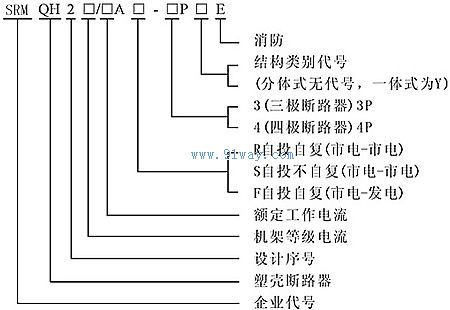
Model meaning
Intelligent controller function
SRMQH2 is a new intelligent dual power conversion switch. The intelligent controller is equipped with keyboard input and LCD display, which can synchronously detect the common power supply (N) and backup power supply (R) in three phases. It has the function of detecting overvoltage, undervoltage, phase failure or loss of voltage. When it is higher than 120% of the rated working voltage value, it is judged as overvoltage, and when it is lower than 75% of the rated working voltage value, it is judged as undervoltage. The backup power supply (R) fault alarm and double division are triggered. The microcomputer processes the detection results and issues corresponding instructions. The processing results can be displayed on the LCD, providing users with a good human-machine dialogue interface. The alarm can also be manually closed by pressing the button. At present, regardless of the working mode, the microcomputer detects abnormal data and delays for 3 seconds to disconnect the abnormal power supply and enter the dual protection state. After a delay of 0-30 seconds, it switches to normal power supply.
Example: In the self switching and self recovery mode, if the common power supply (N) fails, it will automatically switch to the backup power supply (R) for power supply. If the common power supply (N) returns to normal, it will automatically return. If both working power supplies fail, the microcomputer will issue a double split command after 3 seconds. If the power supply returns to normal, it will be prioritized for operation.
Structure and Function
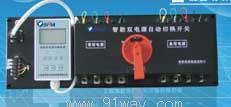
This intelligent conversion switch consists of two main parts: a microcomputer controller and a switch conversion device, which are connected by dedicated cables.
The switch consists of a microcomputer controller, a micro motor, a gear box, a micro switch, an operation keyboard, an LCD display, a molded case circuit breaker, etc. Equipped with automatic, manual, and dual split operation; The characteristics of mechanical and electrical dual interlocking maximize the satisfaction of power supply and distribution needs.
The switch has three status positions for users to choose from: common power (N) on, double off, and backup power (R) on. The switch has the characteristics of small size, light weight, stable operation, and easy use.
work mode
Self investment and self recovery (R) power grid and power grid
Self investment non self recovery (S) type power grid and power grid
Self investment and self recovery (F) type power grid and power generation
(Additional fire protection function (DC24V) can also be added)
Self investment and self restoration (R) power grid - power grid
At the initial startup, it is automatically powered by the commonly used power supply. When there is an abnormality in the power supply (overvoltage, undervoltage, undervoltage, or phase failure), the NA, NB, NC, RA, RB, and RC on the controller LCD will disappear accordingly. The common power supply (N) will automatically switch to a dual split state after 3 seconds of abnormal operation, and then switch to the backup power supply (R) for power supply after a delay of 0-30 seconds. The delay time can be set to 3 seconds at the factory. When the common power supply returns to normal, it will automatically switch from the backup power supply to the common power supply (N) for power supply; The backup power supply (R) is abnormal, and the controller will emit a "beep" alarm sound. This alarm can also be manually turned off. The word 'alarm' disappears on the LCD, indicating that the alarm system has been turned off and there is no 'alarm' function at this time. Pressing the down key will display the word "alarm" and make a beep at the same time, indicating that the alarm system has been turned on.
At the initial startup, it is automatically powered by the commonly used power supply. When there is an abnormality in the power supply (overvoltage, undervoltage, undervoltage, or phase failure), the NA, NB, NC, RA, RB, and RC on the controller LCD will disappear accordingly. The commonly used power supply (N) will automatically switch to a dual split state after 3 seconds of abnormality, and then switch to the backup power supply (R) for power supply after a delay of 0-30 seconds. The delay time can be set to 3 seconds at the factory.
After the common power supply returns to normal, the backup power supply (R) cannot automatically return to the common power supply (N) and needs to be manually returned; At this time, the backup power supply (R) is also abnormal, and the controller will emit a "beep" alarm sound. At the same time, if the power supply is restored to normal after switching to the double split position, priority should be given to putting it into operation. This alarm can also be manually turned off. The disappearance of the LCD "alarm" indicates that the alarm system has been turned off, and there is no "alarm" function at this time. Pressing the down key will display the word 'alarm', and a beep will sound at the same time, indicating that the alarm system has been turned on.
Self investment and self restoration (F) power grid - power generation
The controller detects the common power source (N) and the power generation source (R). When the common power source (N) is abnormal, the control system sends a power generation command (normally open contact) to the generator set to start it. When the voltage of the generator set reaches the normal working voltage value, the controller sends a command to put the power generation source into use, ensuring the normal operation of the generator set. When the voltage of the generator drops below 75% of the rated value, the control system automatically disconnects the load and enters a double split state. After the grid voltage (N) returns to normal, the intelligent system will automatically return from the backup power source (R) to the common power source (N) for power supply after a delay, and the generator set needs to be manually shut down.

 Your location:Home → low-voltage electrical apparatus → dual power switch → SRMQH2/63-1250 type dual power switch

 Zoom in on the image

 Related Products:
 CCQ2 Series Dual Power Switching System
 low-voltage circuit breaker
  Low-voltage fuse
 沪公网安备31010702003255号
