
 Your location:Home → mechanical transmission → Brake | Clutch → electromagnetic brake → JSDZ series AC electromagnetic power-off brake
 |
Product name: | JSDZ series AC electromagnetic power-off brake | |||||
| specification: |   Zoom in on the image Zoom in on the image |
||||||
| Category: | mechanical transmission -- electromagnetic brake | ||||||
| |
Price: | factory price | |||||
| Brand: | Shanghai | ||||||
| Place of Origin: | China | ||||||
| |
Available Quantity: | batch | |||||
| delivery cycle: | Spot goods (or inquire by telephone) | ||||||
 |
|
||||||
1、 Purpose and Characteristics
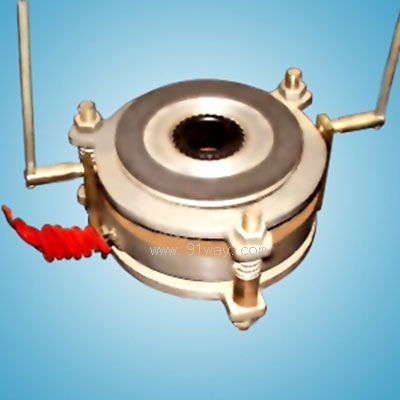
The JSDZ series AC electromagnetic power-off brake is mainly paired with the Y series motor to generate the YEJ series electromagnetic brake three-phase asynchronous motor. Widely used in metallurgy, construction, chemical industry, food, machine tools, printing, packaging and other machinery. Suitable for quick parking, accurate positioning, frequent starting, safe braking (risk prevention) during power outages, and other occasions.
This type of brake has the advantages of compact structure, wide applicability, high working frequency, sensitive action, reliable braking, easy installation and wiring, low noise, no need for rectifiers, and faster braking time than DC brakes. It is an ideal automation actuator.
2、 Working principle
The JSDZ series AC electromagnetic power-off brake is mainly composed of magnetic yoke components, excitation coils, springs, armature components, brake discs, gear sleeves, installation bolts, adjusting nuts and other main components. After adjusting the air gap to the specified value δ, tighten the locking nut with the motor end cover (or mounting plate), connect the gear sleeve to the transmission shaft through a key, and engage the brake disc with the gear sleeve through teeth. When the coil is powered off, friction is generated between the brake disc, armature, and machine base under the action of spring force, which is transmitted to the transmission shaft through the gear sleeve to brake the shaft. When the coil is powered on, under the action of electromagnetic force, the armature is attracted towards the magnetic yoke, causing the brake disc to release and the transmission shaft brake to be released.
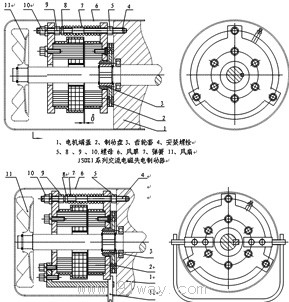
1. Motor end cover 2, brake disc 3, gear sleeve 4, installation bolts
5. 8, 9, 10. Nut 6, hood 7, spring 11, fan
JSDZ1 series AC electromagnetic power-off brake
3、 Installation and adjustment
3.1 Assembly method
3.1.1 First, fix the gear sleeve (3) onto the motor shaft (or the shaft that needs to be braked), and position the two ends of the gear sleeve (3) on the shaft with retaining rings.
3.1.2 Install the brake disc (2) in the correct direction on the gear sleeve (3), so that the outer teeth of the gear sleeve (3) mesh with the inner teeth of the brake disc (2), and the brake disc (2) can move flexibly axially on the gear sleeve (3).
3.1.3 Loosen all hex nuts, screw the mounting bolt (4) into the motor end cover (or mounting plate) (1), lock the nut (5), and fix it as a whole.
3.1.4 Adjust the air gap between the magnetic yoke assembly and the armature assembly by adjusting the nuts (9) and (10), so that the air gap δ is the normal working air gap, and the air gap between the magnetic yoke assembly and the armature assembly is uniform at all locations. Then tighten the nuts (9) and (10) together.
3.1.5. Rotate the nut (8) to adjust the magnitude of the spring force, change the torque and suction performance of the brake, and refer to Table 6.3 for the adjustment amount.
3.2 Adjusting Status
3.2.1 Power on the brake separately, and gently rotate the drive shaft by hand after power on. There should be no abnormal noise, and only a "beep" sound should be heard when it is pulled in or disconnected, which can be considered as uniform adjustment of the air gap.
3.3 Adjust the length of the spring before and after adjusting the air gap.
|
Brake model |
Spring free height |
Compressed height |
|
JSDZ-05 |
twenty |
fifteen |
|
JSDZ-08 |
twenty |
fourteen |
|
JSDZ-15 |
twenty-eight |
twenty-four |
|
JSDZ-30 |
twenty-eight |
twenty-three |
|
JSDZ-40 |
twenty-eight |
twenty-one |
|
JSDZ-80 |
thirty-two |
twenty-six |
|
JSDZ-150 |
thirty-two |
twenty-six |
|
Specification data name |
JSDZ-
05 |
JSDZ-
08 |
JSDZ-
fifteen |
JSDZ-
thirty |
JSDZ-
forty |
JSDZ-
eighty |
JSDZ-
one hundred and fifty |
|
Matching YEJ motor base number |
seventy-one |
eighty |
ninety |
one hundred |
one hundred and twelve |
one hundred and thirty-two |
one hundred and sixty |
|
Rated torque (N.m) |
five |
eight |
fifteen |
thirty |
forty |
eighty |
one hundred and fifty |
|
Rated power P20 ℃ (W) |
fifty-five |
seventy |
eighty |
ninety |
one hundred and twenty |
two hundred |
two hundred and fifty |
|
Normal working air gap δ (mm) |
zero point four |
zero point four |
zero point four |
zero point five |
zero point five |
zero point six |
zero point six |
|
Maximum working air gap δ max (mm) |
zero point seven |
zero point eight |
one | ||||
|
Rated voltage (V AC) |
380V (three-phase) 50HZ | ||||||
|
Maximum allowable operating speed (rpm) |
three thousand | ||||||
|
Dimensions |
d |
D1 |
D2 |
D3 |
D4 |
D5 |
M |
b |
h |
L |
H1 |
H2 |
δ |
|
JSDZ-05 |
fourteen point eight |
one hundred and thirty-four |
one hundred and twenty |
twenty |
fifty-three |
seventy-seven |
3×M8 |
five |
sixteen point two |
twenty |
forty-five |
fifty-five |
zero point four |
|
JSDZ-08 |
nineteen point eight |
one hundred and fifty-two |
one hundred and thirty-six |
twenty-two |
sixty-five |
ninety-two |
3×M8 |
six |
twenty-two point six |
twenty |
fifty |
sixty-three |
zero point four |
|
JSDZ-15 |
twenty-four point eight |
one hundred and seventy |
one hundred and forty-six |
thirty |
sixty-five |
ninety-seven |
3×M8 |
eight |
twenty-eight point one |
twenty-five |
sixty-six |
seventy-nine |
zero point four |
|
JSDZ-30 |
twenty-nine point five |
one hundred and eighty-eight |
one hundred and sixty-eight |
thirty-five |
eighty |
one hundred and seventeen |
3×M12 |
eight |
thirty-two point eight |
thirty |
sixty-seven |
eighty-one |
zero point five |
|
JSDZ-40 |
twenty-nine point five |
two hundred and fifteen |
one hundred and eighty-five |
forty |
ninety |
one hundred and thirty |
3×M12 |
eight |
thirty-two point eight |
thirty |
seventy-one |
eighty-five |
zero point five |
|
JSDZ-80 |
thirty-nine point five |
two hundred and fifty |
two hundred and ten |
fifty |
one hundred and four |
one hundred and fifty |
3×M14 |
twelve |
forty-two point eight |
thirty |
sixty-nine |
eighty-seven |
zero point six |
|
JSDZ-150 |
forty-four point five |
two hundred and ninety-one |
two hundred and fifty-five |
sixty |
one hundred and twenty |
one hundred and eighty |
4×M14 |
twelve |
forty-seven point eight |
thirty-five |
eighty-six |
one hundred and three |
zero point six |
|
Fault |
treatment method |
|
1. The brake does not operate when powered on |
1. Check for AC power failure.
2. The working air gap is too large. |
|
2. Brake power supply on one side
Suction, unilateral non suction |
Check if the moving parts of the brake are stuck or if there are any debris. |
|
3. Power on the brake, brake
Friction and smoking at the moving disc |
1. The working air gap adjustment is too small. |
|
2. Uneven working air gap. | |
|
3. The friction plate has reached its wear limit and must be replaced. | |
|
4. The brake cannot stop the car |
1. The rotational inertia of the working system is large, and the torque value of the brake is small. |
|
2. The working air gap is too large and should be adjusted. | |
|
3. The brake disc surface has oil stains and should be cleaned. | |
|
4. The spring is fatigued and broken, and needs to be replaced. |
 Related Products:
 TQWZ3 series electric forklift electromagneti.. DZD5-1000 type electromagnetic brake DZD5-320 type electromagnetic brake DZD5-160 type electromagnetic brake DZD5-80 type electromagnetic brake DZD5-40 type electromagnetic brake DZD5-20 type electromagnetic brake DZD5-10 type electromagnetic brake DZD5-5 type electromagnetic brake YHDE Electromagnetic brake multi speed three-.. Related articles:
 speed reducer
  conveyor elevator gearbox divider backstop Brake | Clutch Brake rectifier electromagnetic brake
  Magnetic particle brake eddy current brake Hydraulic thruster Hydraulic brake system electromagnetic clutch Magnetic Particle Clutch Combination clutch Centrifugal clutch overrunning clutch Cam clutch one-way clutch hydraulic clutch Pneumatic brake pneumatic clutch hydraulic coupling buffer shock absorber drive belt drive wheel drive shaft coupling expansion sleeve Chain wheel chain motor bearing motorized roller industrial remote control
 Home|Quality Commitment|Ordering|Payment method|product delivery|support|Disclaimer|Contact Us
Copyright®2011 www.91way.com Copyright.
Phone:+86-21-66770508 +86-13916500500 Fax:+86-21-66108310
Email:91way@163.com Wechat:40606422
沪ICP备2021005791号  沪公网安备31010702003255号

