
 Your location:Home → low-voltage electrical apparatus → relay → voltage relay → JY series voltage relay
 |
Product name: | JY series voltage relay | |||||
| specification: |   No image available No image available |
||||||
| Category: | low-voltage electrical apparatus -- voltage relay | ||||||
| |
Price: | factory price | |||||
| Brand: | |||||||
| Place of Origin: | China | ||||||
| |
Available Quantity: | batch | |||||
| delivery cycle: | Spot goods (or inquire by telephone) | ||||||
 |
|
||||||
Purpose:
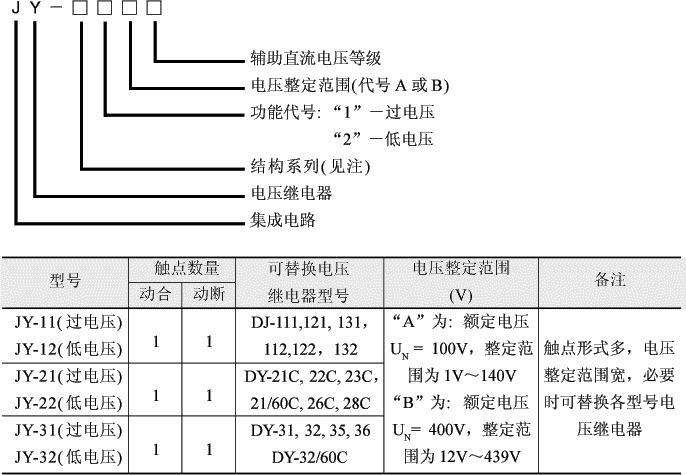
JY-10、 20. The 30 series integrated circuit voltage relay is a static, transient, and AC voltage relay. It can be used in relay protection devices for generators, transformers, and transmission lines as an action element for overvoltage protection or low-voltage interlocking. This relay is composed of an integrated circuit to form an execution circuit, which has the characteristics of high sensitivity, fast action time, low power consumption, and easy setting. The DC power supply and output relay of the relay are monitored by signal indicator lights, and the relay has 2 sets of large capacity contact outputs. Users can directly control the protected equipment according to specific conditions. The relay action value is set by the dial switch on the panel, which is intuitive and convenient.
Relay model name:
Note: (JY-10 represents protruding type, JY-20 represents protruding insertion type, JY-30 represents embedded insertion type) In order to facilitate users to replace various types of voltage relays, please refer to the following table for comparison:
Working Principle:
The input voltage is converted into an appropriate voltage by a voltage to voltage converter, and through the setting of the operating value and active bandpass filtering, it undergoes full wave rectification. The pulsating voltage is compared and integrated, and the detector judges the integrated voltage. When the integrated level exceeds the detection level, the detector outputs a high level to drive the output relay to operate.
This relay adopts a new type of integral judgment circuit, which makes the action time and return time of the relay fast, and the transient overshoot is also small, with strong anti-interference performance.

Usage:
Firstly, carefully observe the panel of this relay, where the two ZK switches in the upper left corner are used for setting UD and △ U. For example, if you have a relay with UN=100V or (Type A) in your hand, when the UD switch is turned to 13V, the UD setting value is 13V, and so on. You can obtain a setting value of 1V through the switch. If it cannot meet your needs and then use the MN dial switch in the lower left corner for fine adjustment, please calculate according to the formula U=UD (1+M.N)+△ U on the panel. The calculation method is as follows: if U=100V or (Type A) you need U=130V, you can first set UD to 13V, and then calculate M=9 and N=0 through the formula. After setting according to the above method, when the applied voltage U=130V, the right indicator light will change from green during normal operation to red, and the relay will act. The setting range is shown in the previous table (△ U is generally set to zero).
Main technical parameters:
5.1 Rated Value
a) Rated AC voltage: 100V, 400V;
b) Frequency: 50Hz;
c) Rated auxiliary DC voltage: 48V, 110V, 220V.
5.2 Setting range (see previous table) 5.3 Action time
a) When the overvoltage is twice the set value, the action time shall not exceed 30ms;
b) The action time at low voltage -0.5 times the set value shall not exceed 30ms.
5.4 The return time shall not exceed 45ms.
5.5 Action consistency: not greater than 2.5%.
5.6 Fixed value error: not greater than ± 2.5%.
5.7 Return coefficient: overvoltage not less than 0.9, low voltage not greater than 1.1.
5.8 Power consumption
AC power consumption: not exceeding 1VA at rated voltage.
DC power consumption: Under rated auxiliary DC voltage, the power consumption before relay action shall not exceed 3W, and the power consumption after action shall not exceed 6W.
5.9 Contact Performance
When the time constant of the inductive load is 5ms, the breaking capacity of the relay contacts is not greater than 2A when the AC voltage is 250V, and not greater than 5A when the DC voltage is 24V.
5.10 Working conditions
a) High pressure range of 80kPa-16kPa;
b) Environmental temperature -10 ℃ -+50 ℃
c) The relative humidity of the air shall not exceed 90% (monthly average minimum temperature of 20 ℃);
d) Strong external magnetic induction intensity is not allowed in the place of use;
e) The place of use does not allow conductive dust or corrosive gases that damage metals and insulation;
f) The place of use does not allow explosive hazards or media filled with dust;
g) The place of use does not allow the presence of severe mold;
h) Strong vibrations and impacts are not allowed in the usage area;
i) The place of use should have rain, snow, wind and sand protection devices and not be filled with water vapor.
5.11 Insulation Resistance
The insulation resistance between the relay housing and each terminal, as well as between electrically unrelated circuits, shall not be less than 300M Ω.
5.12 Dielectric Strength
The insulation strength between the relay housing and each terminal, as well as between electrically unrelated circuits, should be able to withstand an AC voltage of 2kV, 50Hz for 1 minute without flashover or breakdown. The same group of contacts should be able to withstand 1kV, 50Hz AC voltage for 1 minute without flashover or breakdown.
5.13 Anti interference performance
Compliant with GB7261 and GB6261 "Electrical Interference Test for Static Relays and Protection Devices".
Wiring diagram behind the relay:
The contact in the figure is the state where the relay is applied with DC auxiliary voltage, but the AC voltage is zero (i.e. overvoltage does not act, low voltage acts). When neither DC nor AC voltage is applied, that is, when the relay is in a power-off state, the contact state of the overvoltage relay (JY-11, 21,31) is the same as the contact state in the figure, while the contact state of the low-voltage relay (JY-12, 22,32) is exactly opposite to the contact state in the figure.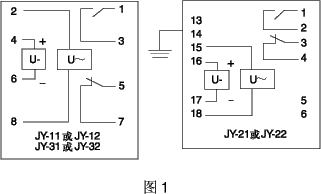
Relay external dimensions and opening dimensions:
See Figure 1 in the general structural system for the structure of 10;
See Figure 3 in the general structural system for the 20 structure;
See Figure 7 in the general structural system for the 30 structure.
Ordering instructions:
8.1 Relay name and model.
8.2 Auxiliary DC voltage rating and voltage setting range (if there are special requirements, please specify separately).
8.3 If the contact form is a special requirement, please specify it separately.
8.4 Order quantity.
 Related Products: Related articles:
 low-voltage circuit breaker low-voltage contactor Low voltage transformer relay
  thermal relay Temperature relay time relay Universal relay intermediate relay power relay current relay overcurrent relay voltage relay
  signal relay Flash relay Differential relay Impact relay Position relay Frequency relay Phase relay Locking relay pressure relay gas relay Coaxial relay Polarized relay automotive relay Leakage relay Phase failure relay solid state relay electromagnetic relay Explosion proof relay Module relay Other relays Relay socket Reclosing relay Acceleration relay Power direction relay Synchronous grounding relay Insulation monitoring relay Counter | timer Low-voltage fuse starter electromagnet resistor Low-voltage arrester power capacitor Low voltage reactor dual power switch Low voltage isolator changeover switch Master Electrical Appliance terminal block plug socket electromagnetic chuck Electrotechnical equipment lighting distribution box Low voltage protector Electric cabinet door lock handle Building electrical appliances
 Home|Quality Commitment|Ordering|Payment method|product delivery|support|Disclaimer|Contact Us
Copyright®2011 www.91way.com Copyright.
Phone:+86-21-66770508 +86-13916500500 Fax:+86-21-66108310
Email:91way@163.com Wechat:40606422
沪ICP备2021005791号  沪公网安备31010702003255号


