
 Your location:Home → low-voltage electrical apparatus → Low voltage transformer → voltage sensor → VSM025A Hall Voltage Sensor
 |
Product name: | VSM025A Hall Voltage Sensor | |||||
| specification: |   Zoom in on the image Zoom in on the image |
||||||
| Category: | low-voltage electrical apparatus -- voltage sensor | ||||||
| |
Price: | factory price | |||||
| Brand: | |||||||
| Place of Origin: | China | ||||||
| |
Available Quantity: | batch | |||||
| delivery cycle: | Spot goods (or inquire by telephone) | ||||||
 |
|
||||||
|
model |
VSM025A |
|||
|
IPN |
Primary rated input current |
ten |
mA | |
|
IP |
Measurement range of primary current |
0~±14 |
mA | |
|
ISN |
Rated output current on the secondary side |
twenty-five |
mA | |
|
KN |
turns ratio |
2500:1000 |
||
|
RM |
Measure resistance (VC=± 12V) |
When IP=± 10mA: 30-350 |
When IP=± 14mA: 30-235 |
Ω |
|
(VC=±15V) |
When IP=± 10mA: 100-460 |
When IP=± 14mA: 100~315 |
Ω | |
|
VC |
power supply voltage |
±12~±15(±5%) |
V | |
|
IC |
current consumption |
VC=±15V 10+Is |
mA | |
|
Vd |
insulation voltage |
2.5KV effective value/50Hz/1 minute between the primary and secondary circuits |
||
|
εL |
linearity |
<0.2 |
%FS | |
|
X |
precision |
TA =25℃ VC=±15V ±0.7 |
% | |
|
I0 |
Imbalance current |
TA =25℃ <±0.15 |
mA | |
|
IOT |
Imbalance current temperature drift |
IP=0 TA =-25~+85℃ <±0.35 |
mA | |
|
Tr |
response time |
90% of VPN ≤40 |
μs | |
|
TA |
Working environment temperature |
-25~+85 |
℃ | |
|
TS |
Storage environment temperature |
-40~+100 |
℃ | |
|
Rp |
Internal resistance of primary coil |
TA =25℃ 190 |
Ω | |
|
Rs |
Internal resistance of secondary coil |
TA =85℃ 55 |
Ω | |
|
standard |
Q/3201CHGL02-2007 |
|||
Dimensions (mm)
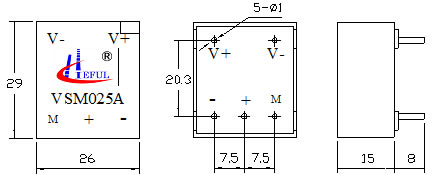
External wiring diagram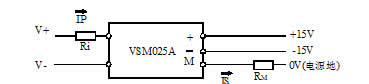
Instructions for Use
1. When measuring voltage, the Ri resistor is connected in series on the primary circuit of the sensor. To achieve optimal accuracy of the sensor, the size of Ri should be selected as much as possible to make the input current around 10mA.
2. Scope of work: Considering the internal resistance of the primary coil (compared to Ri, to maintain the temperature difference as low as possible) and isolation, this sensor is suitable for measuring voltages ranging from 10 to 500V. To ensure the stability of measuring resistance, the power of Ri should be at least 4 times the rated power (usually above 10W). 3. When soldering the sensor to the circuit board, a low-temperature soldering iron should be used, and the soldering time should be as short as possible, otherwise it may cause an open circuit in the internal wiring of the pins.
4. The socket position for installing sensors on the circuit board must be completely consistent with the pin size, and the pins should not be artificially squeezed, otherwise it may cause open circuits in the internal wiring of the pins.
 Related Products:
 A-VSM800DAT Series Hall Voltage Sensor VSM1200DP Series Hall Voltage Sensor CG5-24Q/ φ 65 × 230 Type 24KV Voltage Senso.. A-VSM800D Series Hall AC Voltage Sensor VSM800D Series Hall Voltage Sensor CG10-101 type 12KV voltage sensor CG10-102 type 12KV voltage sensor CG10-103 type 12KV voltage sensor CG10-105 type 12KV voltage sensor CG10-107 type 12KV voltage sensor Related articles:
 low-voltage circuit breaker low-voltage contactor Low voltage transformer
  L-V current transformer L-V voltage transformer zero-sequence transformer Precision Transformer Miniature transformer DC current transformer current sensor voltage sensor
  Intermediate converter relay Counter | timer Low-voltage fuse starter electromagnet resistor Low-voltage arrester power capacitor Low voltage reactor dual power switch Low voltage isolator changeover switch Master Electrical Appliance terminal block plug socket electromagnetic chuck Electrotechnical equipment lighting distribution box Low voltage protector Electric cabinet door lock handle Building electrical appliances
 Home|Quality Commitment|Ordering|Payment method|product delivery|support|Disclaimer|Contact Us
Copyright®2011 www.91way.com Copyright.
Phone:+86-21-66770508 +86-13916500500 Fax:+86-21-66108310
Email:91way@163.com Wechat:40606422
沪ICP备2021005791号  沪公网安备31010702003255号

