1、 Characteristics of HSM1 series circuit breakers
The main technical performance of HSM1 series plastic shell circuit breakers has reached the international level of the 1990s. It has the characteristics of compact structure, small size, high short-circuit breaking capacity, no arcing, modular installation of internal accessory devices, enhanced safety with terminal protective covers, and different colors for the "base" and "cover plate" to enhance aesthetics.
The moving and stationary contacts and contact rods (connecting plates) of this series of circuit breakers are designed in a parallel shape, fully utilizing the electric repulsion before the short-circuit current of the line reaches its maximum value, causing the moving and stationary contacts to be repelled and limiting the increase of arc current; In addition, aromatic insulation materials that can release gas under the scorching heat of the arc are installed around the static contact to absorb arc energy, cool the arc, shrink the arc column, and greatly reduce the backward spraying of the arc. At the same time, an arc extinguishing device with arc gas dissociation is used to achieve zero arc distance. The application of the above new technologies greatly improves the short-circuit breaking capacity of circuit breakers and reduces the volume of complete electrical equipment.
The modular insertion installation of auxiliary devices and the provision of protective covers for terminals make the use of circuit breakers safer and more reliable.
2、 Purpose and Scope of Application
The HSM1 series plastic shell circuit breaker (hereinafter referred to as the circuit breaker) is suitable for circuits with AC 50Hz (or 60Hz), rated insulation voltage of 690V, rated working voltage of 690V and below, and rated current of 12.5A-800A. It is used to distribute electrical energy, perform infrequent closing and opening under normal conditions, and provide protection in case of overload, short circuit, and undervoltage of lines and equipment.
Circuit breakers with rated shell level current of 400A or below can also be used for infrequent starting of squirrel cage motors, breaking during operation, and providing protection in case of motor overload, short circuit, and undervoltage. This circuit breaker has isolation function.
The circuit breaker complies with standards such as IEC60947-2, IEC60947-4, GB14048.2, GB14048.4, etc.
Circuit breakers are suitable for the following working environments:
1. The altitude of the installation site shall not exceed 2000m;
2. The temperature of the surrounding medium shall not be higher than+40 ℃ and not lower than -5 ℃;
3. In a medium without explosive hazards, where there are no gases or conductive dust that can corrode metals or damage insulation;
4. A place without rain or snow invasion;
5. Pollution level 3;
6. Installation Category III
Installation method of circuit breaker: The basic installation method of circuit breaker is vertical installation, but it can also be installed horizontally.
3、 Classification
1. Divided by the purpose of the circuit breaker: distribution protection type; Motor protection type.
2. Divided by wiring method: pre board wiring; Rear wiring of the board;
Plug in board front wiring (only Inm=125160250A three pole, four pole, 400A three pole)
Plug in board rear wiring (only Inm=125160250A three pole, four pole, 400A three pole)
Pull out board front wiring (only Inm=400A four pole, 630800A three pole, four pole)
Pull out board with horizontal and vertical wiring (only Inm=400A four pole, 630800A three pole, four pole)
3. Divided by operation mode: direct operation with the handle; External rotation handle operation; Electric operation.
4. Classified by release type: only instantaneous action release (electromagnetic release code 200); Thermal ten electromagnetic release (compound code 300).
5. Divided by number of poles: Two poles; Three poles; Four poles.
There are six types of neutral pole (N-pole) in a four pole circuit breaker:
Type A: The N pole does not have an overcurrent release installed, and the N pole is always connected and does not open or close together with the other three poles;
Type B: The N-pole does not have an overcurrent release installed, and the N-pole is connected and disconnected together with the other three poles;
Type C: The N-pole is equipped with an overcurrent release, and the N-pole is connected and disconnected together with the other three poles;
D-type: The N-pole is equipped with an overcurrent release, and the N-pole is always connected and does not open or close together with the other three poles;
Type E: Neutral wire breakage protector is installed on the N pole, and the N pole is connected and disconnected together with the other three poles;
F-type: Neutral wire disconnection protector is installed on the N pole, and the N pole is always connected and not combined with other three poles.
6. Classified by accessory devices: with accessory devices, without accessory devices
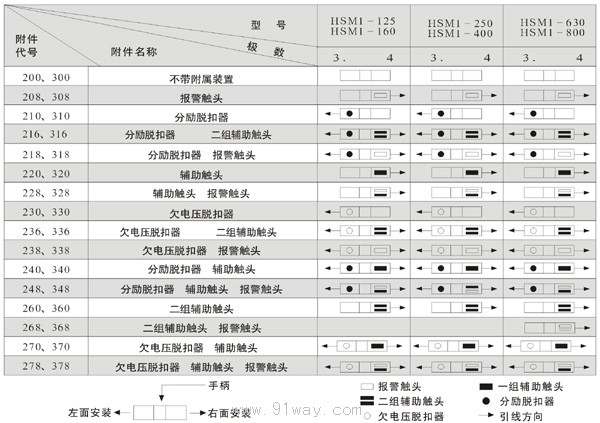
Table 1 Release Method and Accessory Device Code
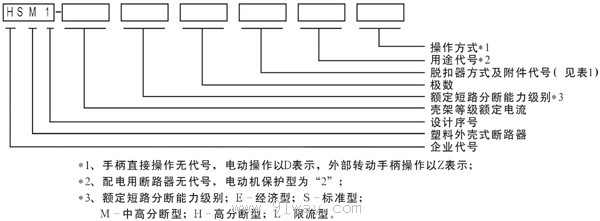
4、 Model and meaning
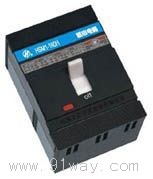
HSM1 series plastic shell circuit breaker

 Your location:Home → low-voltage electrical apparatus → low-voltage circuit breaker → Molded Case Circuit Breaker → HSM1 series plastic shell circuit breaker

 Zoom in on the image
 Related Products:
 DZ931 Marine molded case circuit breaker
 low-voltage circuit breaker
  Molded Case Circuit Breaker
 沪公网安备31010702003255号
