Main Performance Parameters of BGJ Series Bearing Heater
|
Specification and Model |
BGJ-2.2-2 |
BGJ-3.5-3 |
BGJ-7.5-3 |
BGJ-20-3 |
BGJ-60-3 |
BGJ-75-3 |
|
power |
2.2KVA |
3.5KVA |
7.5KVA |
20KVA |
60KVA |
75KVA |
|
Working voltage |
220V |
380V |
380V |
380V |
380V |
380V |
|
Rated Current |
20A |
20A |
40A |
60A |
160A |
180A |
|
control method |
0-99 points |
0-999 seconds |
0-999 seconds |
0-999 seconds |
0-999 seconds |
0-999 seconds |
|
Aperture reference |
φ30-φ80 |
φ70-φ120 |
φ100-φ170 |
φ160-φ230 |
φ230-φ300 |
φ300-φ900 |
|
Workpiece width limit |
120mm |
170mm |
180mm |
220mm |
280mm |
350mm |
|
Heating temperature limit |
250℃ |
250℃ |
250℃ |
250℃ |
250℃ |
250℃ |
|
Gross weight of the whole machine kg |
fifty |
sixty |
seventy-five |
three hundred |
five hundred |
eight hundred |
| Outer packaging dimensions (mm) |
550*400*320 |
750*500*950 |
800*550*1000 |
1500*800*1300 |
1850*980*1250 |
1850*980*1250 |
BGJ series induction heaters are widely used in the manufacturing of many enterprises such as metallurgy, railways, oil fields, machinery, and motors. They are used for induction heating of annular hole shaped parts such as bearings, couplings, gears, and bushings that need to be installed during the maintenance of machinery.
The BGJ series heater adopts the principle of electromagnetic induction, which treats the processed hot workpiece as the secondary of the coil. When powered on, the heated workpiece undergoes thermal expansion from the inside to the outside under the action of induced current, thus meeting the requirements of interference fit assembly.
1. Improve assembly quality, with uniform heating, high precision, and the ability to maintain the inherent quality of workpiece surface hardness.
2. Improving work efficiency and rapid heating speed can not only reduce the labor intensity of workers, but also improve assembly progress, achieving civilized production.
3. Reasonable structure, advanced technology, easy operation, safe and reliable, and no fire hazard.
4. Save energy, reduce costs, and improve efficiency, saving 100% fuel compared to oil heating and 60% electricity compared to electric furnaces.
5. After the heating stops, the BGJ series induction heater automatically stops the residual magnetism during operation for less than 3CS, which meets the ZJS-004 standard. The BGJ series induction heater is an ideal heating device for civilized, efficient, and safe production.
The BGJ series 2.2-2 heater control unit is a lightweight product that is suitable for use in small workpiece heat sets. It has the advantages of small size, light weight, and easy mobility. The shell is made of insulating material, which is safe and reliable during use.
This heater adopts time control, and the time can be selected within the range of 0-99 minutes. Different specifications of yokes can be equipped according to the size of the user's workpiece. When using, yokes of similar size to the workpiece aperture can be selected to achieve the best heating efficiency for the workpiece.
1、 Operation and usage method:
1. Connect the heater plug to 220V AC and the red indicator light will turn on.
2. Insert the workpiece into the yoke and place it flat on the end face of the heater core. (See Figure 1)
3. Turn the time dial to the desired time position, press the "Start" button, and heating will begin.
4. When the time comes to disconnect the main circuit,
2、 Notes on BGJ series induction heater
1. When using a yoke, care should be taken to handle it gently, and collisions or heavy blows are strictly prohibited. When not in use temporarily, it should be properly stored and placed in a box. If the surface is corroded or uneven, it should be promptly re ground before use to avoid increasing noise.
2. It is prohibited to have no yoke on the end face of the iron core. When heating the workpiece, press the "start" button.
3. Heating the workpiece once does not meet the assembly requirements, and the heating time can be extended.
BGJ-3.5-3 and BGJ-7.5-3 bearing heaters
Introduction
The BGJ series 3.5-3 and BGJ7.5-3 bearing heaters adopt two heating control methods: time and temperature.
The time control is digital display. It can intuitively understand the heating time of the workpiece, with a time error of less than 5% per minute.
Temperature control is mainly used for first piece monitoring.
The machine is equipped with a trolley for easy mobile use on the production site.
The heating time of this heater can be selected within the range of 0-99 minutes.
The heating temperature can be adjusted within the range of 0-399 ℃.
1、 Operation and usage method:
1. Connect the heater power cord to a 380V AC power supply.
2. Move the lifting handle of the yoke, raise the yoke, and then place the workpiece on the yoke or horizontally on the vertical column of the iron core. Refer to Figure 1 and Figure 2, then turn back to the original position and start heating.
3. Determine the control mode, use time control to adjust the temperature dial to the maximum, place the sensor probe aside and do not use it. Turn the time dial to the desired heating time, press the "heating" button to start working. When using temperature control to heat the workpiece, turn the time dial to the maximum, set the temperature to the desired heating temperature, and press the "heating" button to start working. (Attach the sensor probe to the end face of the workpiece).
4. When the time or temperature is up, the main circuit is disconnected, the demagnetization action is completed, the lifting handle is turned, and the yoke is rotated to remove the workpiece for installation.
2、 Attention:
1. When connecting the power supply, pay attention to whether the voltage and current match, and ground the machine.
2. When placing heavier workpieces flat on the vertical column of the machine's iron core, asbestos boards should be added to the table to prevent excessive temperature, burning of the cover plate, and damage to the components.
3. Generally, when heating bearings, the temperature should not exceed 120 ℃. If it exceeds 150 ℃, time control should be used as much as possible to avoid damaging the sensor probe due to high temperature.
BGJ-20-3, BGJ-60-3, BGJ-75-3 type bearing heaters
Introduction
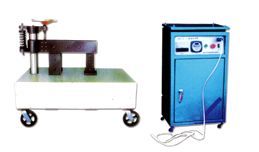
The BGJ induction heater consists of two parts: the main unit and the control box. This machine consists of iron core winding, iron core cross arm lifting mechanism, and movable core column (see Figure 1 and Figure 2). The control mode is equipped with dual control of time and temperature, using fully imported integrated blocks and digital display. The operator can achieve heating time and heating temperature.
1、 Operation
1. Connect the power supply (two-phase 380V AC) according to the nameplate.
2. Connect the output terminal of the control box to the input terminal of the host.
3. Activate the control box ship type main switch, the red light is on.
4. Rotate the handwheel, raise the yoke and turn it 90 ℃, then place the heated workpiece. Select the core column according to the inner hole of the workpiece, place it in the inner hole of the workpiece, rotate the yoke to its original position, and turn the handwheel to make the yoke tightly contact the core column. This product should be used on a flat surface, and the degree of compression should be adjusted to minimize noise.
5. When heating the workpiece for the first time, turn the time dial to the desired heating time, set the time to the maximum, measure the temperature of the workpiece with a thermometer, and when the temperature is reached, record the time for the next use. (Additional thermometer)
6. When heating up, the green light will turn off and the red light will turn on. At the same time, the demagnetization action will be completed. Wear asbestos gloves to remove the workpiece for installation.
2、 Precautions
1. When powering on, check whether the power supply voltage matches the heater nameplate and whether the grounding is good.
2. The yoke of the heater must have good contact with the end face of the iron core to prevent noise or high current overload from burning out the coil assembly and electrical components.
3. A layer of asbestos board should be laid on the countertop to prevent the workpiece from overheating and scorching the countertop.
4. For workpieces with special specifications and sizes, they need to be heated upside down for a second time.

 Your location:Home → Hardware tools → Machinery and equipment → Heating equipment → BGJ series induction heater

 Zoom in on the image
 Related Products:
 HA-II type bearing induction heater
 Universal Accessories
  power tools
 沪公网安备31010702003255号
